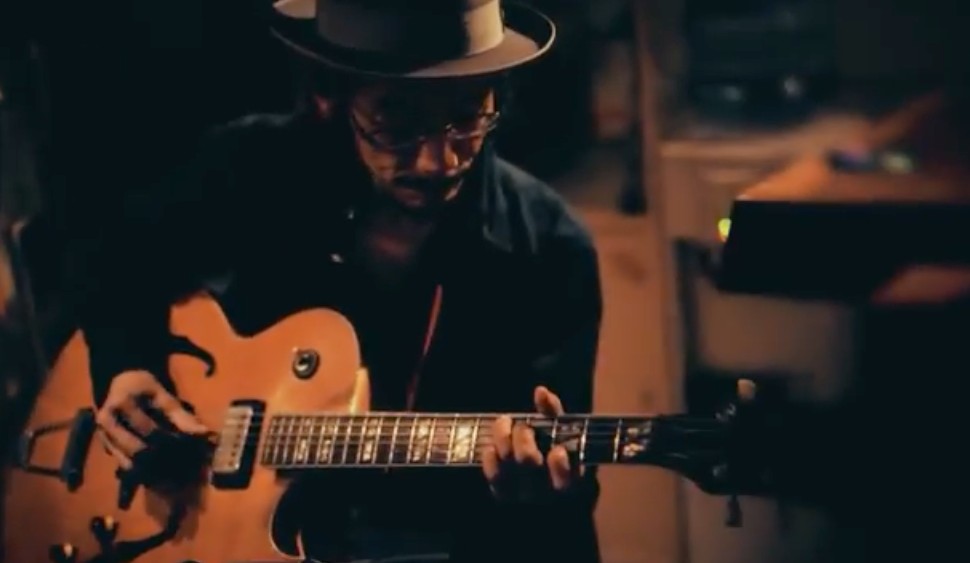
I take guitar lessons from Isao Tsukamoto only once a month. He charges 7,000 JPY (approximately 44 USD), which is quite reasonable considering the quality of the lessons, but it's not cheap for me. Most of his students take two lessons a month, but I enjoy playing songs that are easy enough to learn on my own, so once a month is a good pace for me. He usually teaches me how to arrange songs I've decided to practice.
March is the end of the fiscal year and hay fever season in Japan, and I've been busy and feeling sick, so I wasn't very prepared for the last Sunday's lesson. However, I don't feel awkward even in such situations. Needless to say, how hard I practice is my problem, not his, which makes me wonder why my former piano teacher pushed me to practice hard and expressed her disappointment when I didn't practice enough.
At any rate, we had some extra time at the end of the lesson, so he gave me some advice while I was slowly putting my guitar back into my gig bag. He suggested that I might want to avoid using a capo. I was a bit taken aback and asked if he himself doesn't use a capo. He said he once had one, but after repurposing it as a clip for a rice bag, he never saw it again. He's famous for playing just one guitar, a Gibson ES‑175T, so of course I knew that. On top of that, he said he didn't even own a capo or a slide bar — he can play any chord in any key without a capo, and he can sound as if he's using a slide bar, so he doesn't have to worry about forgetting to pack these small accessories when he performs live. What's more, he only uses standard tuning.
I was so impressed! I told him, "It's like origami folded from one uncut square sheet of paper." It's called 不切正方形一枚折り in Japanese and it's the most basic, strict and ultimate technique in the world of origami. I explained the concept to him, because it's one only origami fans are familiar with, and he seemed to like it. I don't think I can follow his way, but I found it interesting, and I know it'll influence me in some way.
Great post! Lots to learn here. Let me know if you have any questions.
I think teachers like their students to study or practice because it reflects well back on them. 'Wow, that teacher's students learn so fast! She must be a good teacher' kind of thing. Of course, teachers also get invested in their students' success, and want them to succeed. It's painful as a teacher to see a student's skill not develop because their heart isn't in what they're learning, but that's just what happens sometimes.
I agree. I think one of the teacher's job — aside from imparting knowledge — is to encourage perseverance and discipline. After all, practice makes perfect, and any good teacher would be remiss not to remind their students of that by any means necessary. I think the piano teacher had the right attitude.
That's an interesting analogy! The idea of not relying on external tools resonates with me. Thank you for sharing this.
I think if you don't use a capo you'd need to know a lot music theory right? I'd say each to their own
@schmamie @CocoPop Yeah, I know my former piano teacher wasn't bad. I'm the bad student. The reason is really complicated, so maybe I'll write a post about this. I'm still not able to write a long and complicated replies in the comment section! I have to improve my English skills!
@BalaGi Thanks for your comment! He plays various styles of music in the simplest way. I really admire it.
@via-chan The biggest reason that he doesn't use a capo is that, as he said, if you use a capo, the number of frets you can use is smaller. If you don't, you can play one chord in various ways, and they're like synonyms. They're similar but not the same. That fascinates me a lot. Of course, I won't stop using a capo because it's much easier and I also love easy songs! But learning his style is interesting, too.
彼は「まあ、僕は生徒さんたちにカポを使わないのをオススメしてるんです」と言ったんだ。そのおしつけがましくない言い方が、He suggested that I might want to avoid using a capo. で伝わってるかな。
Love this analogy! I also think it means true mastery of an art if one is able to break the big picture down into smaller parts, and then take it from there and build everything up again. I consider myself lucky to know some people who can do it in origami as well.
About the guitar, I've only played it for a short time, which is why knowing the whole fretboard still seems really daunting to me. Still, a more experienced friend of mine said, there are only about 50-60 chords that you need to know. Learning one per day means I could be ready in two months... I don't know if that works in practice, but the fact that he quantified it exactly made it way less scary!
I often consider language learning in the same way. Ultimately, it's all about communicating our emotions and thoughts, and each language does this in a different way. As daunting as grammar might be, knowing that it's a limited and finite set of freely combinable tools is already quite empowering.
Thank you, Gabor! So you like origami, guitar, and languages! How similar our interests are! And yes, these three things are similar, too. I think they all have a kind of logic, and it physically shows up. I'm not sure I can convey exactly what I mean, though.