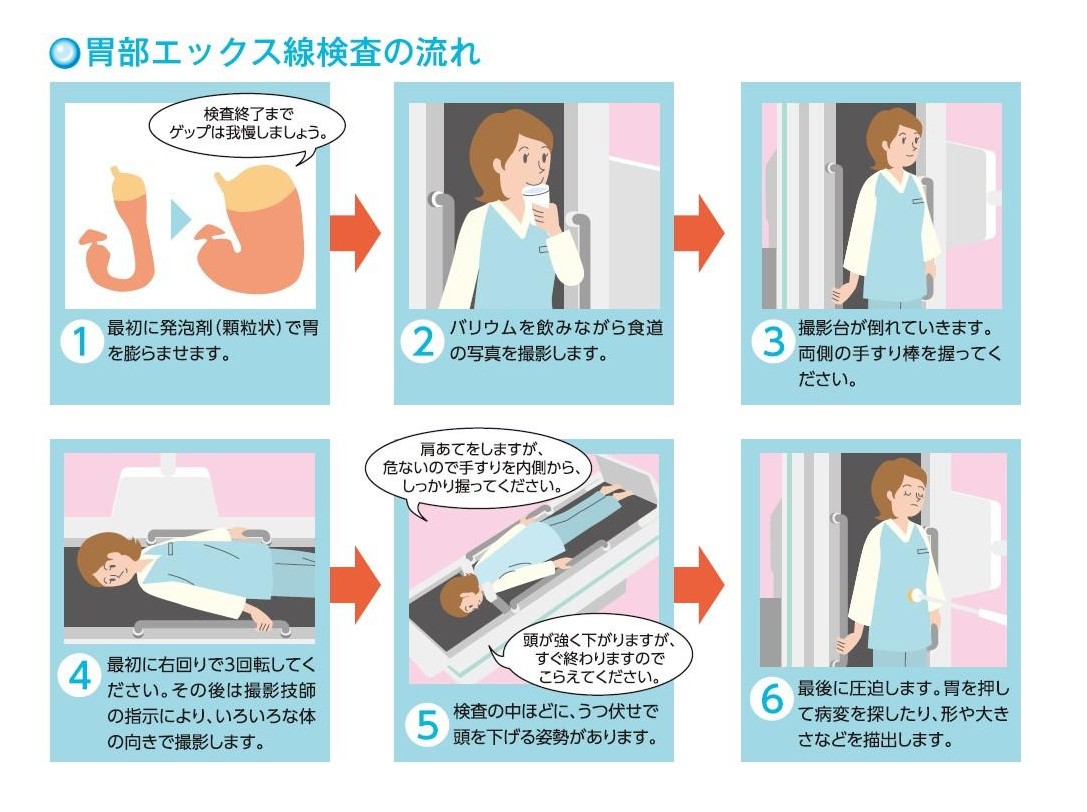
Last month, I had my annual checkup. In Japan, companies are required to offer it to their employees. It includes a stomach X-ray with barium, which is standard. Have you heard of barium? I hear very few countries other than Japan use it. I've only had it once and swore I'd never do it again. You drink this weird, bad-tasting, white, slimy liquid, which makes your stomach expand. You have to hold back burps, or you'll have to drink it again. Then, you lie on a table and grip the side handrails with both hands and get spun like a carnival ride and X-rayed from every angle. On top of that, you'll suffer from constipation and eventually end up pooping white. And if all that isn't horrible enough, there's no guarantee that it'll even detect anything since it often misses symptoms.
It's said that we Japanese stick to this archaic, grueling and almost useless test just to justify the cost of expensive barium equipment. I don’t know if that's true or not, but either way, I've been going back and forth with my company on this issue. I've reminded the person in charge many times that I'm not legally required to take it. However, she's forgotten about it every time, so I've had to repeat the argument every spring. I got fed up with that and decided to take a nasal endoscopy as an alternative this year, and paid for it out of my own pocket. It wasn't cheap, but I was really happy to avoid getting into yet another discussion with her.
I'd heard nasal endoscopy is also unpleasant, but I was sure that it would be more bearable than barium. At least it’s more effective as a health check. When I was asked some questions at a medical interview, the doctor said, "You're lucky. The nasal endoscopy doctor you're seeing on Thursday is very skilled." So, I determined to trust her and not to be afraid.
When I entered the room, the doctor and nurse actually looked professional and skilled. Their instructions put me at ease. I was given a mild anesthetic in my left nostril, and they inserted the endoscope. What intrigued me was that the doctor told me not to close my eyes; closing your eyes makes you focus on the sensations inside your body and feel more pain. That tenses your muscles, making it harder to move the endoscope — and as a result, you feel even more pain. I understood — it's a cooperative task between doctor and patient — so I looked at every corner of the room as he instructed. I felt very little pain.
The monitor wasn't in a position where it was easy to see during the procedure, but I managed to watch it. I was really curious. I of course knew what a human stomach looks like, but it was my first time seeing mine in real time. The doctor told me that my stomach, esophagus and duodenum were in nearly perfect condition. Actually seeing them made an impact on me. It wasn't just knowledge — it was an experience. I started thinking I should take better care of my stomach through a better diet. Getting to know your own body is absolutely fascinating!

Seeing your own stomach sounds really cool! And yeah, that barium procedure sounds extremely uncomfortable. I've never heard of it, so I think we only do nasal endoscopies in Spain.
This mandatory checkup is done, I suppose, because of a high rate of stomach cancer in Japan? It seems intrusive. I would be concerned about the exposure to X-rays. Are the results shared with your employer, or are they kept private? Could you lose your job because of unsatisfactory results?
What a great post. You have some sentences here there are really complex! This was next level)))
@PiAlfa Haha, I'm so jealous! It sounds like Spain is far more civilized than Japan.
@SEQ77 Yes, Japan does have one of the highest rates of stomach cancer, but there are some alternatives to barium. I also want to avoid being exposed to X-rays. The results are sent to both our employer and us. And I hear that when you get unsatisfactory results, in most cases, you're off work during the treatment period and get two thirds of your salary. However, I guess you could lose your job in more serious cases.
@CocoPop Thank you, Uly! Comments like yours keep me motivated to keep writing! As always, I learned a lot from your feedback this time too!
Did I understand it right – they inserted the endoscope into your nostril to look inside your stomach? I've never heard of this procedure! Sounds unpleasant. I've only ever had an EGD, where they insert the endoscope through your mouth.
@BalaGi Yes, you did understand right. I hear a nasal endoscopy is more comfortable than an EGD, because it doesn't trigger gag reflex. I've never had an EGD, so I'm not sure, though.
Well put!!
@via-chan Thanks!