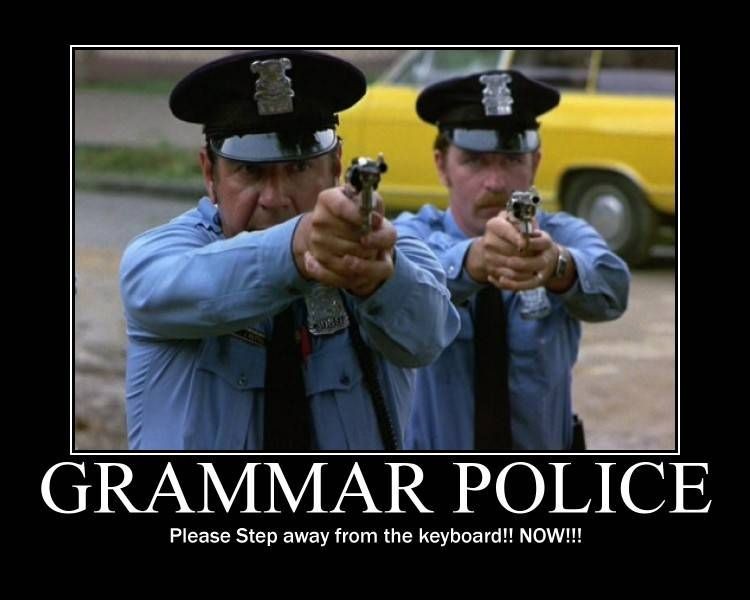
Welcome to the fourth installment of my series, in which I review the book "Says Who?" by linguist Anne Curzan.
Comparatives
The author discusses the linguistic debate about the logic of using the comparative form of certain adjectives, such as ‘unique’ and ‘perfect.’ Grammarians complain that these adjectives operate under a binary condition: Either something is “unique” or “perfect”, or it is not; one thing cannot be more “unique” or “perfect” than another. The author proposes that these adjectives have actually broadened their meaning—not replaced it. Curzan echoes the stance of Patricia O’Conner and Stewart Kellerman on this issue: Comparatives like ‘more unique’ and ‘more perfect’ capture the process of striving toward an ideal or a goal. (I've paraphrased them).
Sometimes, these comparatives just have a more effective rhetorical use. For example, consider this sentence from Martin Luther King, Jr.: “I am in the rather unique position of being the son, the grandson, and the great-grandson of preachers.” The adjective ‘unique’ doesn’t claim that he was the only person in that situation, but suggests it was rare.
I hope you found this paragraph concise enough while still providing helpful information.
Verbing
The grammar of the English language allows for great flexibility. Functional shift—when a word changes grammatical category—occurs frequently and marks an inherent characteristic of English. In fact, English has gained many new verbs through functional shift. However, this has attracted a lot of criticism, particularly regarding the verbing (see what I did there?😁) of nouns with Latin roots. Benjamin Franklin, for one, considered it an “abomination” and a threat to “the purity of our language.” Such was his loathing of some newly verbed nouns that he appealed to Noah Webster, asking him if they could work together on a new book condemning those new verbs. But what were these verbs that troubled Franklin’s mind so much? Here they are: ‘to progress’, ‘to advocate’, and ‘to notice.’
It’s fascinating that these verbs are now in common use. In fact, according to the author, semantic change looks interesting in retrospect. In contrast, however, it causes anxiety and friction in the present. Regardless, I cringed hard when I read Franklin’s letter to Webster. Not because of the content itself, but because of the capitalized nouns (like in German) and the apostrophes (e.g., “your’s” and “occurr’d”)—the guy clearly didn’t know how to write! Oops… there I said it! (Sarcasm)
These were rather complex topics to navigate. So I hope you found my review interesting and informative. Please feel free to leave your comments and contribute to the discussion, so long as you nitpick Franklin’s “creative” use of apostrophes😆.

Your writing is so good! I like it. I am halfway through a linguistics degree, and the only discipline I have not yet deeply studied is semantics. So I found this post rather interesting.
For some reason this reminded me of how author Mark Twain hated the German language lol. If you're interested, here is an funny video about it (in English), https://www.youtube.com/watch?v=VcekIrFjwe0 RobWords in general has some great videos.
It used to be the 'e' in occurred was pronounced as a separate syllable (like o-curr-ed) but in Franklin's time, in speech, the -ed ending as a separate syllable was disappearing. So the -'d ending shows he was writing like he spoke, which made it a more casual letter. No excuse for your's tho.
This book seems interesting -- I might try to find a copy myself!
@via-chan Thank you! I love RobWords!
@schmamie Fascinating! The thing about Franklin is that I left out the historical context. It was shortly after his return to America from France in 1789. In his letter to Webster, Franklin laments the changes in language usage. Specifically, he was deeply concerned—and probably disgusted—that the three aforementioned verbs had made it into "parliamentary language" during his absence.