
Translating the free-verse poem pictured below, by Argentinian writer Alicia Borinsky, was a new experience. Beneath the poem are my two non-literal translations that attempt to encapsulate what's conveyed in the original. I discuss my translation decisions, and in one translation, I experimented with using a dialect, or non-standard English, African American Vernacular English (AAVE), also known as Black English. (I tried to keep the poem's layout, but Journaly has become finicky lately and distorts formatting whenever tables are used. Bolding and intalicizing text are also problems.)
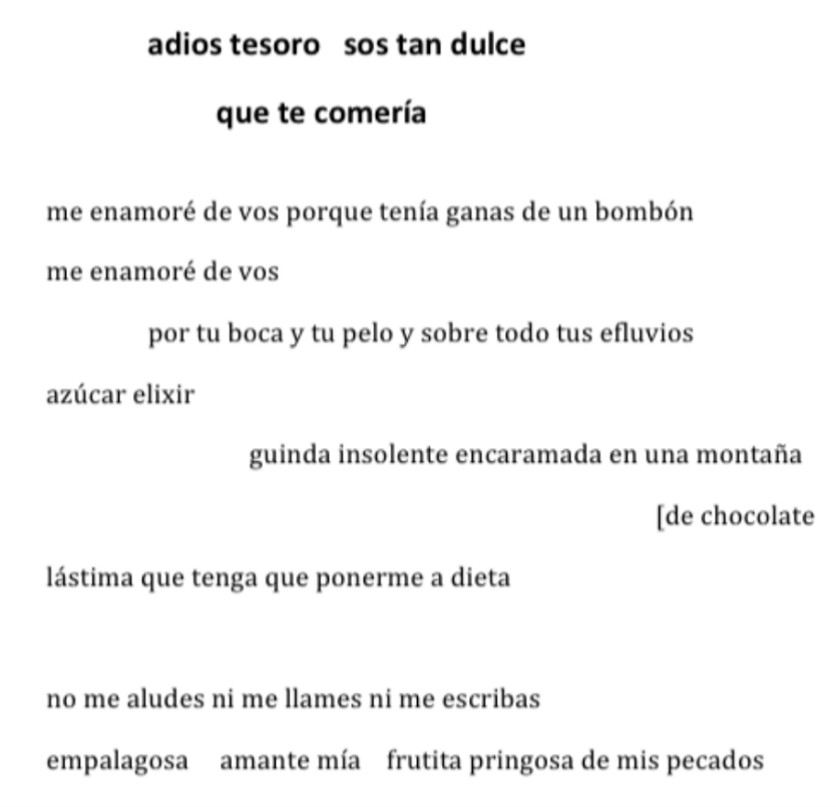
good bye, honey– you’re so sweet I’d eat you up I fell in love with you because I desired passion I fell in love with you your mouth, your hair, and most of all your radiant sweet essence sassy cherry perched atop a mountain [of chocolate sorry I have to go on a diet don’t mention me or call me or write me overly sentimental lover of mine clinging fruit of my sins Translation Decisions Using the theme of sweetness, I looked for connotations of some words. A “bombón” is typically made of chocolate, which is sweet and has a symbolic meaning of love, and passion; hence, “bombón” was translated as “passion”. “Efluvio'' means outpour or something that emanates, so I translated this as “radiant”.“Empalagosa” means overly sweet, cloying. Still remaining with the sweetness theme, I first translated “empalagosa” as “saccharine,” which itself means overly sweet, overly sentimental. Because a reader might confuse “saccharine” with the substance “saccharin,” I used “overly sentimental” instead, even though “cloying” also would have been appropriate. However, I think cloying is more formal and would have rendered a different register. An overly sentimental person might be “pringosa (sticky),” but I thought a better word to describe a person was “clinging” or “clingy” (overly attached or emotionally dependent). EXPERIMENT USING SOME AAVE bye, honey – you so sweet I’d eat you up I fell in love with you cuz I wanted love I fell in love with you your mouth, your hair, most of all cuz you sweet, smell so good sassy like a cherry sittin’ top a mountain [of chocolate sorry, I finna go on a diet don’t be talkin ‘bout me callin’ me writin’ me you just too sentimental steady clingin’ to me ‘n makin’ me sin |
Translation Decisions I experimented with using AAVE in the translation, with an emphasis on the verb “to be,” either where it's missing or where it's used as emphasis. I did not want this translation to be anything that denigrates AAVE, or makes it sound like minstrel, so I limited my use of some phonetic spellings (eye dialect), where “mouth” would become “mouf,” since there is a tendency to change “th” to an “f” sound, and “your” often becomes “yo”. I dropped the ending “g” and “t”, as happens often in other American English dialects. “Finna” means “going to” and is derived from “fixing to,” an expression often heard in the American south. “Steady” indicates that the action being described is occurring consistently or intensely. |

Why not "sugar elixir"?
It should be "no me aludas". Funny. Perhaps there's a reason
"frutita" sounds pretty intimate, playful and almost devilish. I think there must be some (Shakespearean?) equivalent in English
"efluvio" is a subtle (bodily) emission, but material notwithstanding. I wouldn't use radiant here
Thanks for your comments and suggestions, @eugen_blick. This translation was an exercise students did in a translation studies class. I think one of the goals was not to translate the poem word for word, but to use creative license. However, most students translated "azúcar elixir" similar to what you suggest (e.g., sweet scented potion, sugary elixir, heady sugar potion, sugary ambrosia, sugared remedy, candy elixir, radiant seductive elixir, seductive sweetness, eternal sweetness, elixir sugar, sugared aphrodisiac, sugar scented elixir, your emanations, calming sweetness, sugar elixir scent). "Frutita" was translated as "fruit."
In my Translation Decisions, my thoughts were that “efluvio'' means outpour or something that emanates, so I translated this as “radiant," but I can see where this could also mean "glowing / brilliant," so I would translate this differently.