(The following was written as an exercise to describe a photo and the story it tells.)
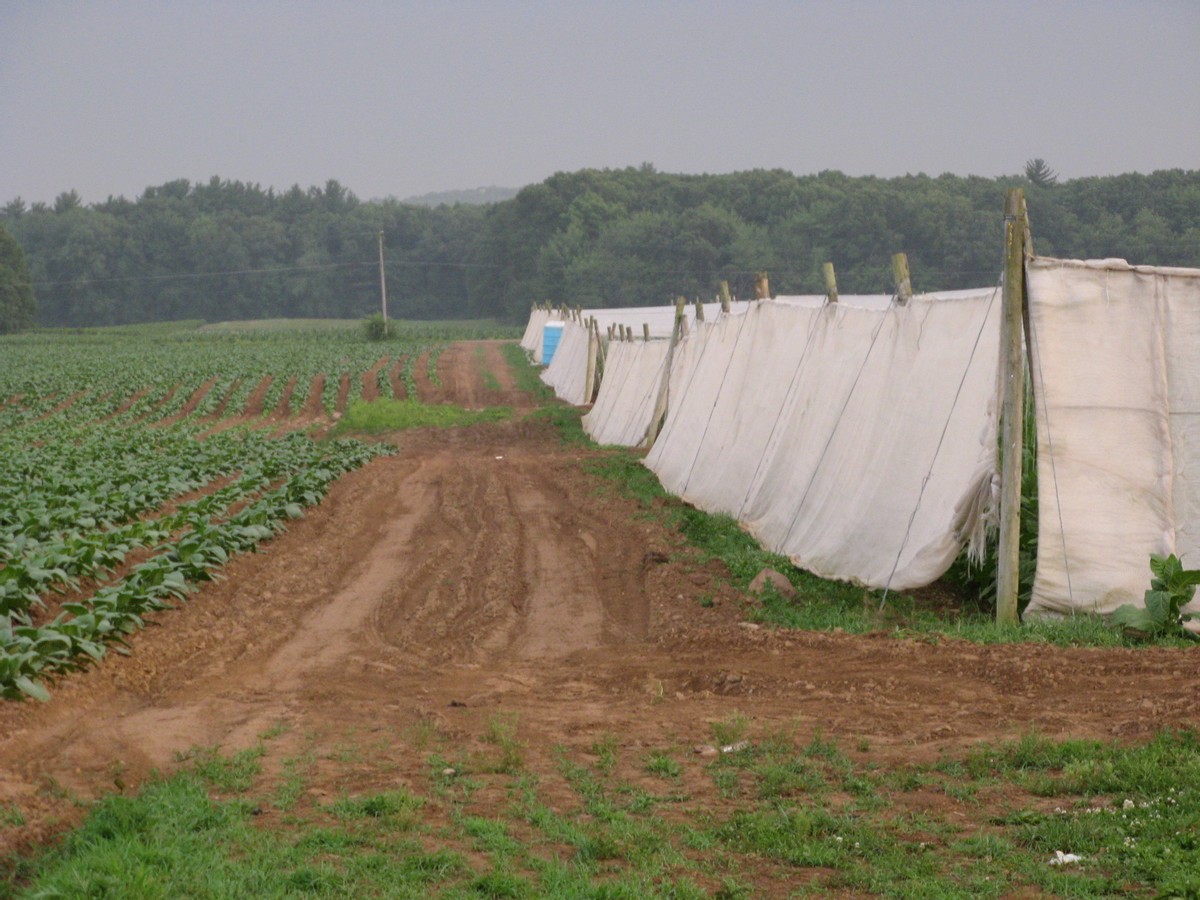
During summers throughout the Tobacco Valley that extends south from Massachusetts to Connecticut, white cloth tents cover thousands of acres of transplanted tobacco seedlings that will grow quickly into nine-foot-tall shade tobacco cultivated since 1901 for the outer layers of premium cigars.
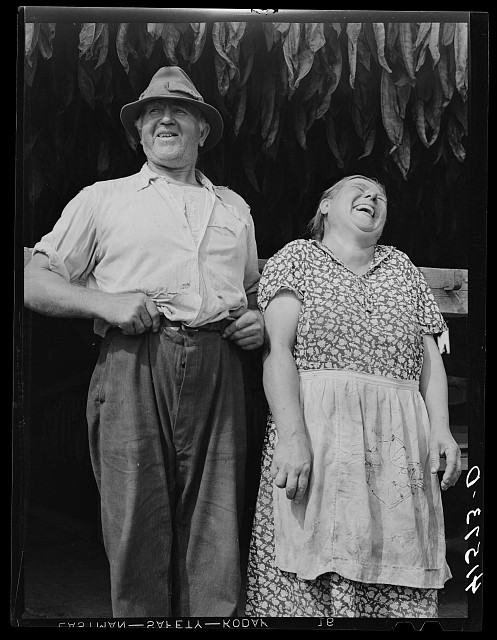
The tobacco industry depends on workers like Polish farmers Mr. and Mrs. Andrew Lyman, whose harvesting expertise has allowed it to flourish. Pictured below in a black-and-white photo taken in 1940 by the Farm Security Administration near Windsor Locks, Connecticut, they stand just outside a tobacco barn where tobacco leaves hang from rafters. The barn, now filled with harvested leaves, is ready to be closed to allow the leaves to dry.
Mrs. Lyman tilts her head back and to the side, amused by something the photographer has said. She is dressed in a patterned dress covered by a light-colored, soiled apron with a design. Her eyes squint as she laughs, with her mouth opening wide to show a missing tooth. Her arms look disproportionately large and long for a woman of her height. They appear to be suntanned, even though the tents filter direct sunlight, or possibly her arms show the dirt from the black tobacco juices or the rich soil that nurtures these prized tobacco plants.
Mr. Lyman stands to the right of his wife, dressed in a tattered light-colored shirt over an undershirt, and ill-fitting pants that he seems to be holding up. In fact, the photographer, Jack Delano, later explained that he made the couple laugh by telling him his pants were falling down. ‘The thought of such a catastrophe apparently made them break up [laughing].’ (History by Zim). Mr. Lyman’s laughter is more restrained than his wife’s as he peers to his right. His parted lips show decayed, worn teeth resembling tiny kernels of corn on a corncob. A well-worn hat covers his head and shades his eyes. His face is covered by the stubble of a gray beard.
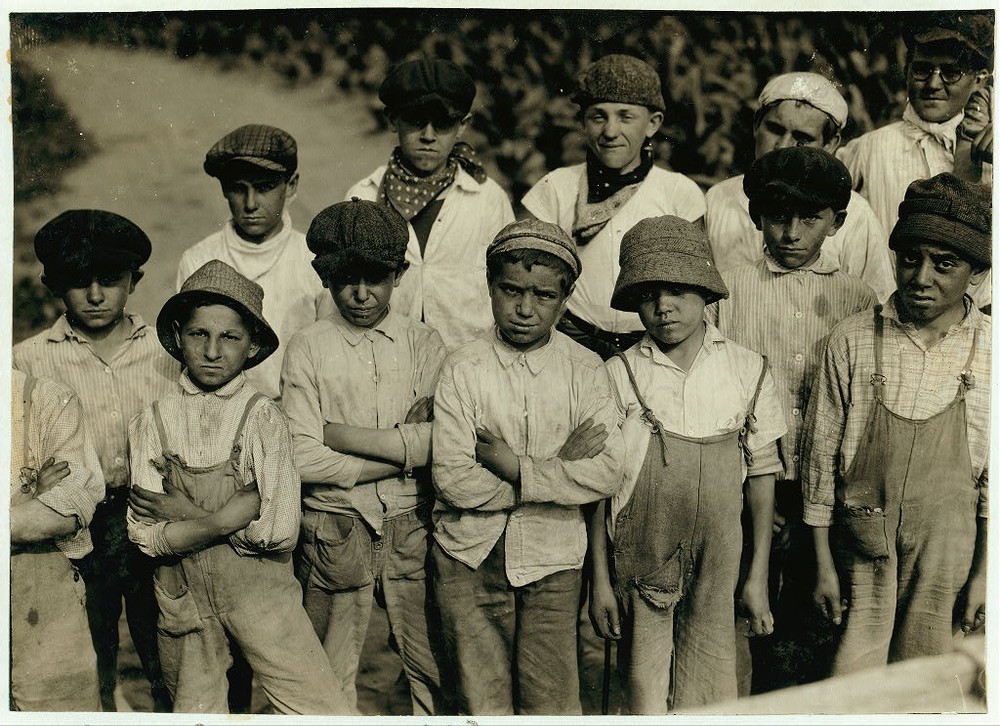
Outside the picture frame stands the photographer from the Farm Service Administration. Likely, there are also bedraggled children as young as nine years old waiting to board a bus to take them home after having spent hours scooting on their buttocks through damp soil to harvest tobacco leaves. Their fingers are likely crusted with black tobacco tar, and their faces are streaked with dirt, which they will soon scrub away. Their sad eyes reflect fatigue and pain. Or perhaps there are the African American college students who have been recruited from the South when labor becomes scarce (ConnecticutHistory.org).
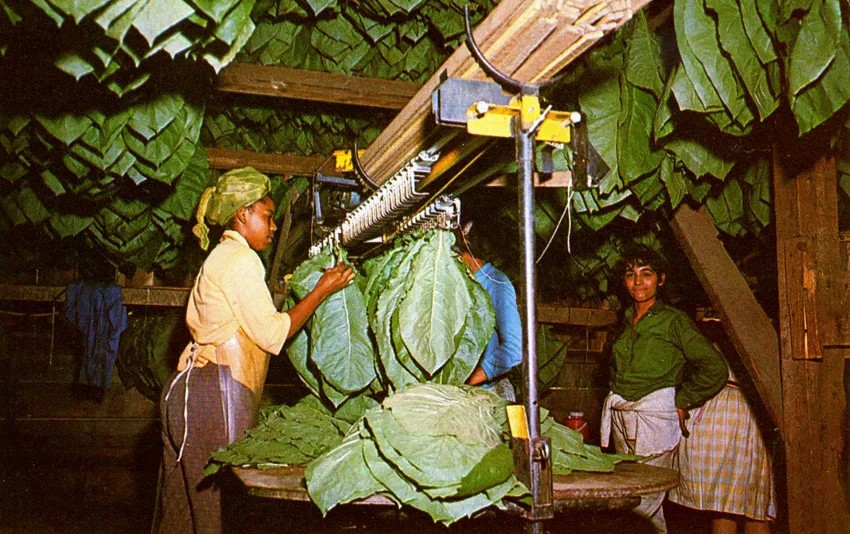
As I look at this photograph, I’m reminded of the other Polish workers who worked alongside me during the summers of the 1960s. I was always amazed by the heft of the Polish women – their thick legs and arms suiting the arduous tasks of picking tobacco in the humidity of stifling hot tents, their bodies layered in clothing, and their heads covered with bandanas. I wondered then, and now, how many leaves they had picked and carted, how many hours and years they had labored to perfect the art of harvesting. This expertise consisted of repetitive, mind-numbing tasks. It’s an expertise that is burned into my memory. More than sixty years later, I still remember the monotonous steps of sewing tobacco leaves: pair two leaves, insert them into a slot, repeat until all the slots are filled, press a button to send a threaded needle through the leaf stems, attach the string to a wooden lath, pull a lever to remove the lath, shake the leaves to make sure none fall, and hang them on a rack so that another worker can pick them up to hang from the rafters. So, the process began again and again, eight hours a day, five days a week.
While I worked just to earn money during the summer, many of the migrant workers like Mr. and Mrs. Lyman had no other options. Their expertise, together with their inability to speak English well, bound them to a back-breaking job. Their expertise did not lead to a life made in the shade.
Mr. and Mrs. Lyman
Child Workers
Teenager Sewing Tobacco Leaves; Sewn Leaves Hanging from the Rafters
Shade Tobacco Field
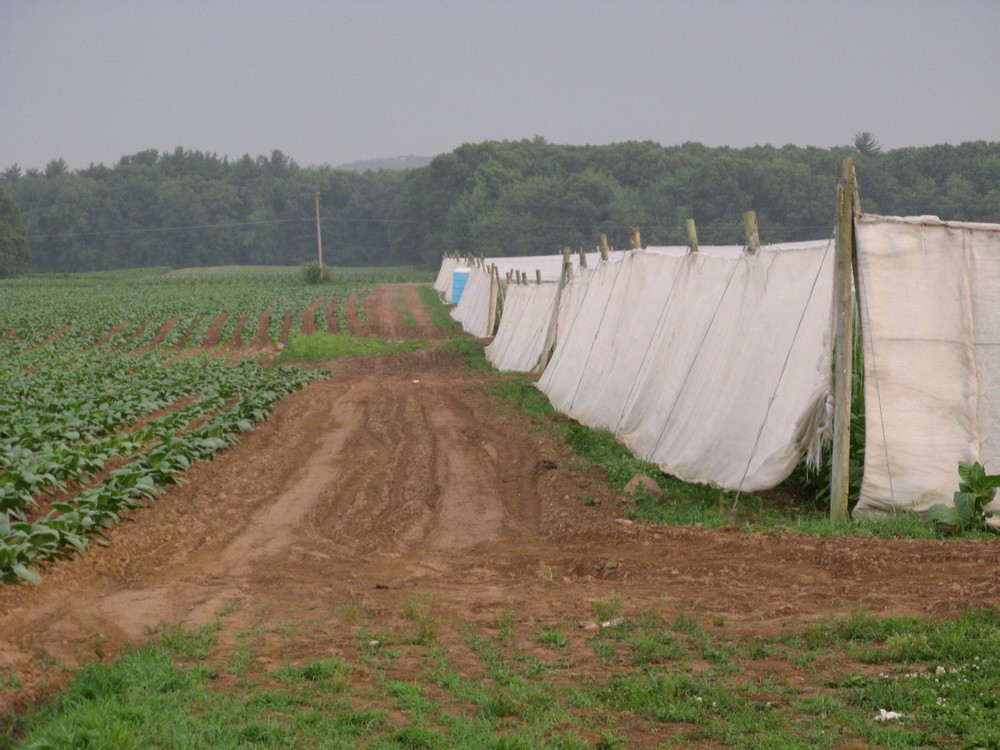

Very interesting! Thank you for sharing!! The Tabasco field picture reminded me of Alabama I used to visit. There were lots of cotton fields.
Thank you. I was in the process of shortening this, but I must have selected ‘publish’ instead of ‘edit’. Many people are surprised to learn that tobacco grows in the northeast in the U.S. The industry isn’t as big as it used to be. Martin Luther King worked on tobacco in Simsbury, CT when he was a teenager. The town I grew up in wasn’t very diverse, so I looked forward to working during the summers to meet people. I never could understand what Jamaican workers said. Their accents were vey thick. It was exhilarating being around people who spoke other languages. I’m curious. What brought you to Alabama? I think you’ve traveled to more parts of the USA than I have.
How very interesting. As a Cuban-American, I find it fascinating that there's a tobacco and cigar culture here in the US — an so far north! Beautiful writing and beautiful pictures!
Thank you, Uly. The shade-grown industry is shrinking due to high costs and competition, so many farmers have switched to sun-grown Broadleaf. Harvesting shade-grown tobacco is a labor-intensive process. Working "on tobacco" was like a rite of passage for many teens.
When I was in Tampa, Florida, I saw lots of old cigar factories. Most of them were closed, but some were still open. My American friend and I stopped by some and saw how they make cigars. It was fascinating. I bought some old cigar boxes and I've used them as paint containers.
I used to visit Alabama because I have a good American friend there. A couple of years ago, she lost her husband because of the COVID. I used to have some American students there as well. One of my students also passed away a couple of years ago. China painting in the States is a dying art form. I think I saw tobacco fields in Alabama as well. Manybe Kentucky.
I'd love to share this story with my friend in Michigan. It's interesting for her as well!
I've collected cigar boxes to transform them into other objects. Some boxes are just too beautiful to alter. It's OK to share the story with your friend.
@SEQ77 Do you mean you decorate the boxes using cartonnage? I'd love those boxes! They're very elegant.
@yumiyumayume You can embellish the boxes with collage paper and other elements or repurpose them for another use, such as creating a guitar. Here are some ideas on Pinterest for altering cigar boxes: https://www.pinterest.com/search/pins/?q=upcycled%20cigar%20boxes
Wow, thank you for sharing! I love those ideas! I'd love to try!!