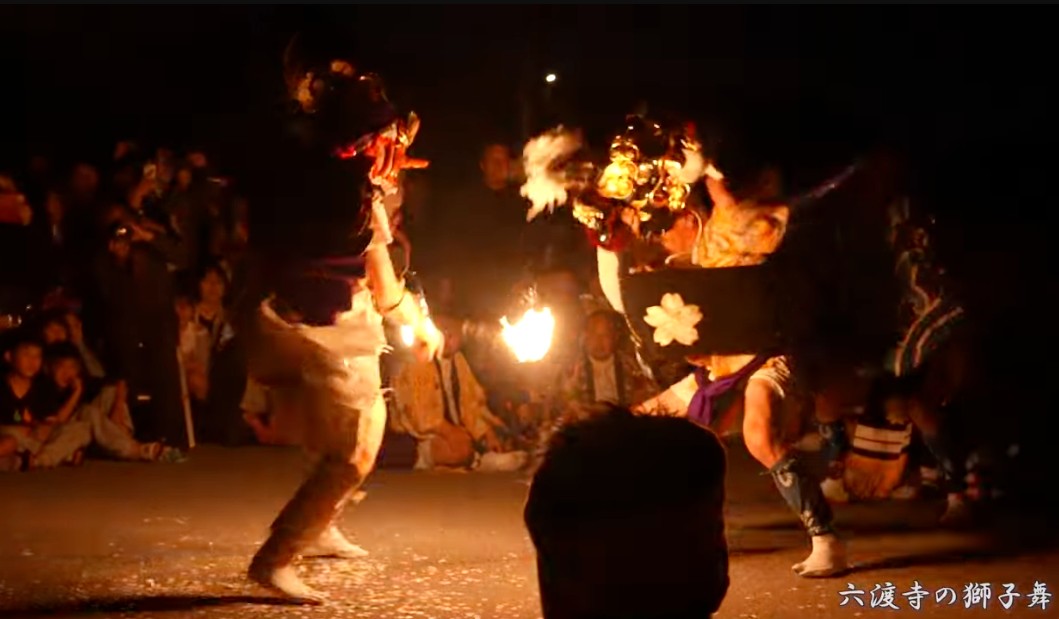
When I was a kid, the events I looked forward to the most were the spring and fall festivals, particularly the lion dance. In the spring, which is the rice planting season, kids dance, and in the fall, which is the rice harvesting season, adults dance. Long ago, Japanese people heard about the Asian lions of India, known in Japan as shishi. They had never seen lions, so to them, this was actually an imaginary creature.
There are various lion dances throughout Japan. Toyama, my hometown, is one of the areas where people celebrate the dance most enthusiastically. Toyama's lion dance is unique because it's also performed with tengu, which, in Japanese folklore, are supernatural creatures with human characteristics. The tengu basically represents good, while the lion represents evil in Toyama's lion dance. But in a sense, good and evil aren't strictly on opposite sides of the spectrum, and we enjoy watching them battle. Here's a video of one in a nearby area of my childhood home:
https://youtu.be/OM0BiYYN-rE?si=io_KoqTWYwm7rAkD&t=1020
The dancer holding the torches is the tengu. The head of the lion is made of dense wood. Here's another video showing how the festival begins. They first go to the shrine of the town where the festival is to be held. This video is bright and clear, so you can see that the lion is manned by five men, hence its ten legs.
https://www.youtube.com/watch?v=VkOiIUAZGc0
The performers visit every house in the town and perform about two pieces at each house. At my childhood home, they always performed the typical dances Hitoashi and Yassaburi. If a family had a wedding that year, they give a generous offering, and the performers offer a special dance such as the Rokushaku. They also perform the Kiriko, a very short piece featuring a young tengu at households that have had a funeral and aren't accepting offerings. After visiting all the homes in the town, it's already late at night. They perform the Killing of the Lion dance in front of the mayor's home. It's a drawn-out, slow piece and the best tengu dances to it. Naturally, he's dead tired but dances with his last ounce of energy. Despite the name of the piece, the lion doesn't die. There's a local belief that if the lion were actually killed in the dance, it would bring famine that year. In our culture, we don't strictly distinguish between good and evil — we believe both are necessary in their own way.
Wow ! Festivals like this are the reminder of why I am learning Japanese and Japan's culture. Thank you for rekindling my motivation. I was surprised when you said that they go to EVERY house in town. What a beautiful sense of community.
@bakerboy001 This festival is small and held separately in each small village or town. The music and dances of each place have developed in their own unique ways, and everyone believes that their own festival is the best. As the season approaches, people gather to practice together, and visiting EVERY house during the festival is important for running the community.
@Akiko That is fascinating ! I didn't realize that it was such an art to be honed by the performers. Now that you mention it, this seems very Japanese. Do you know if there is some sort of competition that decides the best dance ? As you said, I assume it is kept in the community.
@bakerboy001 The Annual Lion Dance Performance Gathering features lion dances from various local festivals. While each festival's dance is usually performed only within its own community, this event brings them together in one place for everyone to enjoy. But it's not a competition and they don't judge which one is best. In this event, visitors, including tourists, are welcome to watch.
https://www.takaoka-st.jp/event/shishimai/
That was both beautifully written and so informative! Great work!
Thank you, Uly!
Everyone looks so happy and enthusiastic in the videos... everyone just looks like they're having so much fun. It's just fun for fun's sake... everyone dancing so diligently. In the first video you linked, it's so wholesome seeing the little kids sitting in the adults laps watching :(((( very cute. Also loved the flutes, very intense
@via-chan One of my oldest memories is of the lion biting my hand while my mother was holding me up. It's a magic charm for children's health. I was also cute back then 👶
@CocoPop Thank you, Uly! I noticed your additional suggestions this morning and took in all of them. They're interesting as always!
Always a pleasure!