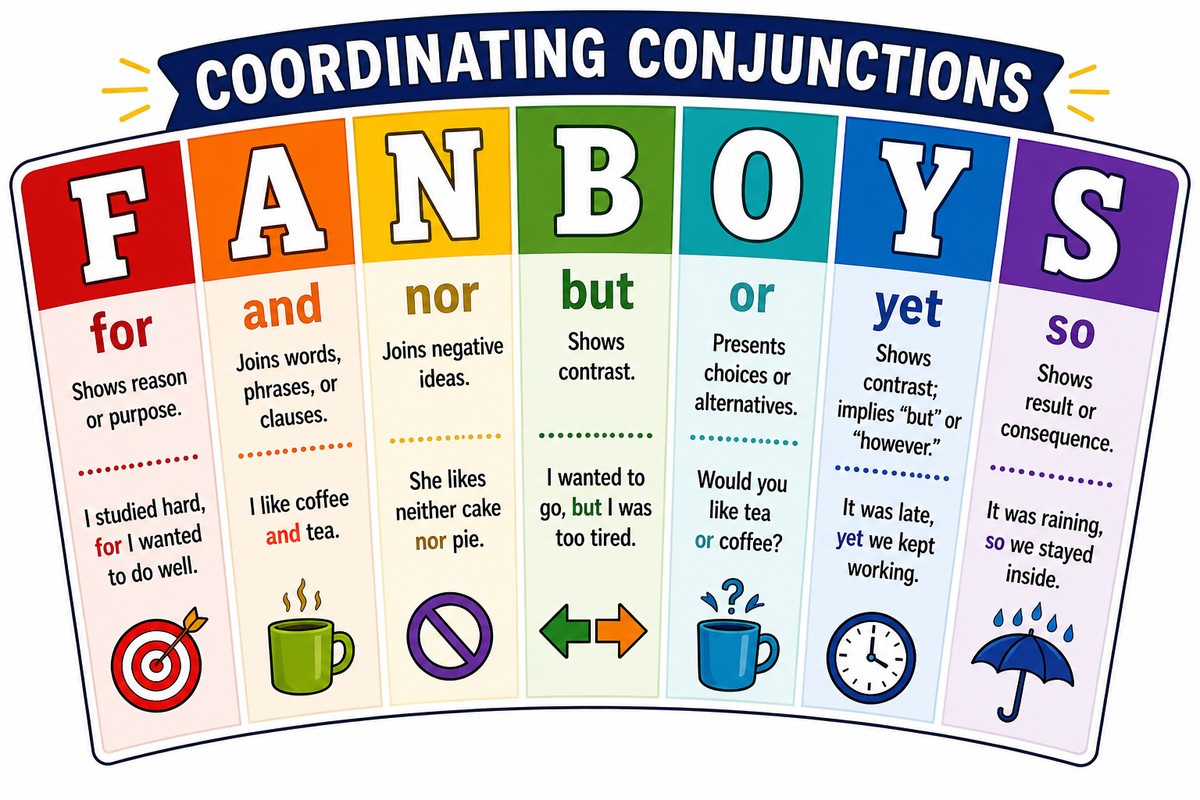
By now, you've noticed the small words that link words, phrases, and clauses so that your sentences flow smoothly. These words are called coordinating conjunctions, which connect two or more elements of the same grammatical type. You use coordinating conjunctions to combine ideas and show how they relate to each other. There are seven of them (for, and, nor, but, or, yet, so). They're easy to remember because their first letters spell FANBOYS. Each conjunction has a different job to do:
For: explains a reason; similar to 'because.' I was tired, for I didn't sleep well. (Note that **for** is formal and literary and is rarely used in speech or writing.)
And: adds things: I like pizza and ice cream.
Nor: used with negative ideas. He doesn't like dogs, nor does he like cats.
But: shows a contrast. I wanted to go to the party, but I had too much homework.
Or: gives you a choice. Do you want chocolate or vanilla ice cream?
Yet: similar to "but," indicating contrast or exception. He studied many hours for the test, yet he failed.
So: shows a result. It started raining, so we stayed inside.
One of their important jobs is connecting independent clauses. An independent clause is a sentence that can stand on its own because it's a complete thought. It doesn't depend on anything else for it to have meaning. For example, "I am hungry, but I don't have any food" is joined by "but." "I am hungry" and "I don't have any food" are complete thoughts.
When you use FANBOYS to connect two independent clauses, you usually put a comma before the conjunction. However, when you're just connecting words or phrases, you don't need a comma. For example, "She likes basketball and soccer" doesn't need a comma.
The next time you're writing, remember FANBOYS. These seven coordinating conjunctions can help you connect ideas, create more complex sentences, and make your writing clearer and more interesting.

How cool!
It should be emphasized that for used in the sense of because is rare enough in speech and writing to be considered Shakespearean at best, if not downright biblical. All the others are used constantly in writing and speech.
Thanks. I mentioned that “for” is rarely used in speech and writing. Adding “Shakespearean” and “biblical” emphasizes just how rare it is.