There are several objects that are unique in their appearance. Let's try to find some. One of the most knowns are snowflakes. They look exactly the same. However, in 1885, Wilson Bentley proved that if we look at them closely enough, we will notice their unique hexagonal structure. Indeed, sometimes we should look close enough to see. Imagine ourselves on a riverside; it is likely that each pebble or grain of sand we observe will be different from the others. How about the texture of trees? Definitely, we will observe a similar-looking pattern, but I am not sure if it is exactly the same.
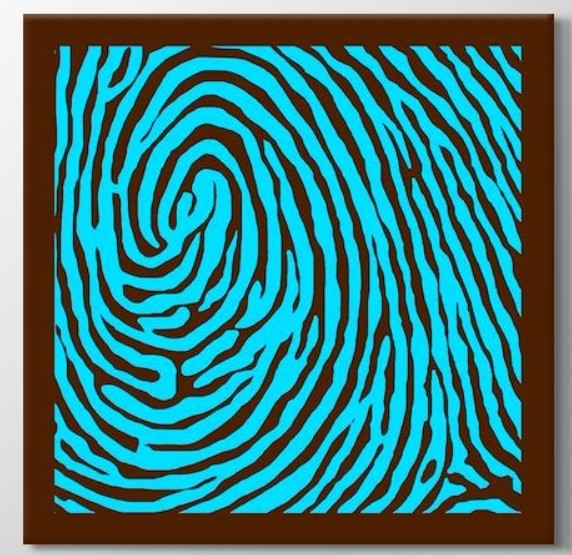
Human fingerprints are by far the most well-known unique patterns, I believe. Have you ever considered when and how someone might think that our fingerprints are totally different from those of other people? It is difficult to know whether this was an easy task for ancient people or an impossible one. Upon my readings about this topic, I find that this is mostly a moot point. Some people believe ancient people knew and used that information for their security. While others argue that it is impossible to record and preserve fingerprints. They suggest it is also nearly impossible to compare with the interested person's fingerprint.
When I was at primary school, probably in first or second grade, on Monday morning, everyone was talking about the burglary in our school. Some thieves had stolen some computers. Probably the director was sad about the data loss, but he gave a speech, saying the fingerprints had been collected and the thieves would be caught at the end. That was the first time I heard about this magical property of fingerprints, and I could not help thinking about how they would find thieves. Because the thieves' fingerprints may never have been taken before, and they simply cannot match the collected samples with any real person. Considering that, there is no doubt that people in old times did not use fingerprints for such a reason. They might have used it to verify that some specific people have fingerprinted a document or something similar. Still examining those fingerprints and verifying that they belong to the owner is hard work.
In the holy Muslim book (Qur'an), there is a reference to this unique structure of fingerprints in the Surah Qiyamah, which was dated to the early 7th century. In the 3rd verse, the Qur'an asks, "Do people think We cannot reassemble their bones?" to refer to the recreation after death. And the following verse (75:4) is "Yes ˹indeed˺! We are ˹most˺ capable of restoring ˹even˺ their very fingertips." Many footnotes in translations agree that the verse refers to the fact that every human has a unique set of fingerprints. I have no clue if the fingerprints were known to be unique for each individual in the 600s. Yet this is a nice way to declare that humans are to be recreated to their littlest thing.
I love detective stories; the word 'fingerprint' reminds me of detectives.
Is it possible that our fingerprints are unique just for the sake of detectives?
ÖM.