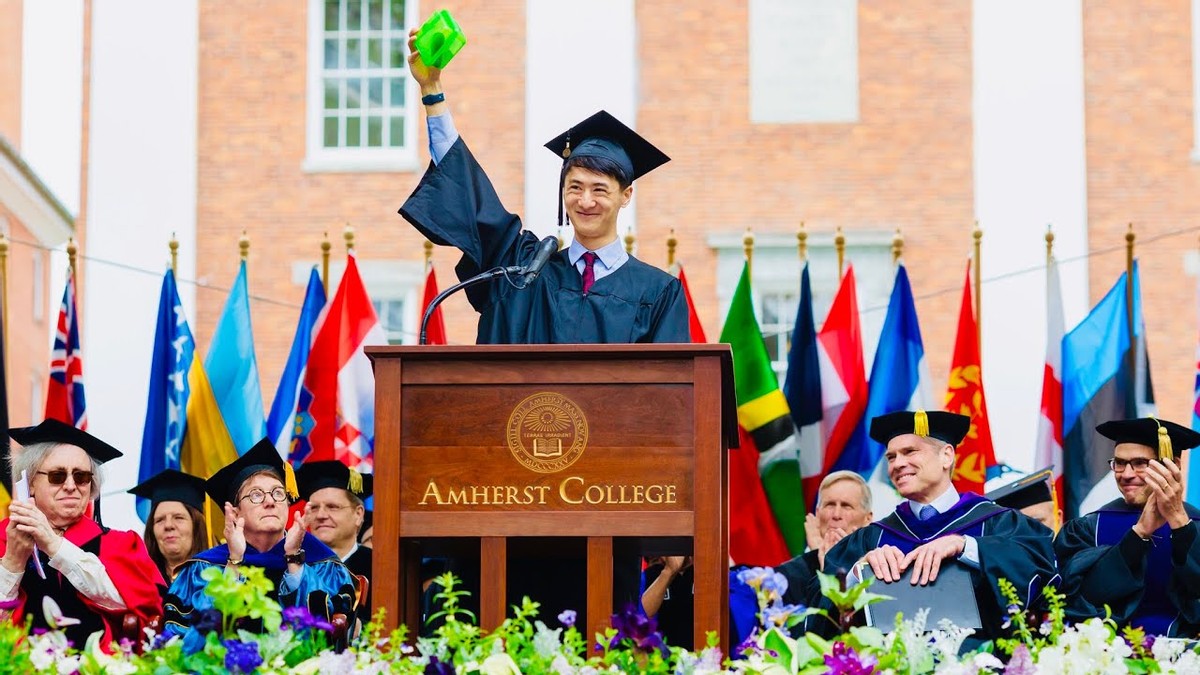
Earlier this year, a graduation speech by Thomas Ye, a Chinese-American senior at Amherst College, went viral on the internet after it was shared on multiple social media platforms, including Twitter, TikTok, and YouTube. In his speech, Thomas Ye used three analogies on items found in a green to-go box to communicate three life lessons that resonated deeply with many people (you can check out his full speech on YouTube). First up, he brought out a piece of green paper, using it to emphasize the point of staying "green" - forever keeping the spirits of humility, curiosity, and energy, just like a green freshman. To introduce his second point, Thomas presented a pickled cucumber, using its fermentation process to illustrate his second point: tough moments are very much a part of the natural rhythm of life and success. Just like how a pickle's fermentation causes it to be temporarily unappetizing but ends up exceptionally delicious in the end, tough moments and even failure are an especially important part of success, and people should learn to accept them. Finally, Thomas used the analogy of his own experience with the card game Bridge to demonstrate the importance of building social connections.
Throughout Thomas Ye's speech, it wasn't the content of the message he communicated that made the speech so popular - although the message was profound and intuitive - it was how he communicated this message, his cordial and easygoing demeanor, that really captured the hearts of so many people, Chinese & American alike. For me, I was totally enthralled by the way Thomas delivered the speech. His confident yet still relaxed & personable attitude left me in awe and made a deep impression on me.
Just the past Thursday evening, June 26, the hosts for one of the activities that I am currently participating in, the Keystone Rising Global Leaders (KRGL) Conference held by students of the Beijing Keystone Academy, invited Thomas Ye to give a short lecture during an online meeting. Through this, I was able to personally meet him online, talk to him, and really just learn from him.
A central topic Thomas Ye discussed in his lecture was how to be a leader. According to him, one of the most essential traits of a leader is being a good communicator—not only in how you express yourself but also in truly listening to people with diverse perspectives. In short, effective communication is the ability to connect with those around you, which inspires others to follow you. This aspect of communication was something I hadn't considered before. Until then, I had assumed that simply conveying my ideas clearly would be enough to gain support. Thomas Ye helped me realize that communication is less about transmitting information and more about creating a genuine connection—giving people a personal reason to follow you.
From Thomas Ye, I learned that storytelling is a key part of establishing that connection with people. Everybody loves a story, and using a fun and interesting story to introduce your message can really compel people to take an interest in what you are saying. Furthermore, telling your unique story also makes your message seem more personal while also allowing people with similar experiences to connect. Correctly using a narrative in your message can make all the difference in inspiring people to take part in your initiative.
Indeed, the use of storytelling is nowhere more evident than in Thomas Ye's own deliveries. In his Amherst graduation speech, Thomas Ye wove his personal anecdote of using green to-go boxes during the pandemic to build the analogies of the green paper, pickles, and bridge card game and introduce his central message; in his Thursday lecture, Thomas Ye used his experience of learning bike riding, ballet, and bridge as a college student to illustrate the importance of trying out new things. Even when introducing the importance of storytelling as a communication skill, Thomas told a story where he compelled people to donate books through a story of getting free books to demonstrate its effectiveness. As I listened to his many anecdotes, I felt a strange sensation of closeness to him and a desire to follow him, as if I were under his spell, a spell made up entirely of words. I thought: this is what a true master in communication should be like. I looked to him because he could build stories and words in such a magical way. I am awed by the power he possesses in his words, and at the same time, when I look back at myself, I am sullened by the gap between us. This mixture of admiration & somberness is what the experience of listening to Thomas Ye gave to me.
However, beyond just the amazement at his storytelling skills, Thomas Ye's firm spirit as a leader also deeply inspired me. In his lecture, almost an extension to his previous graduation speech, Thomas Ye talked about how staying "green," being curious and open to change, can sometimes be extremely frustrating as you feel like you are not making any progress and, in the end, wasting your time. He talked about how he himself had experienced instances in college where he felt that he was falling behind due to spending too much time on seemingly useless initiatives. However, the important thing Thomas Ye did was not let himself be discouraged by the self-doubt and keep on pursuing his choices. He saw social issues that needed to be solved and started campaigns that may have started slowly, but eventually came into fruition. Over time, Thomas Ye slowly grew to become a leader through these stubborn endeavors, while in the process refining his communication, organization, and leadership skills to end up as the accomplished graduate on the day of the Amherst College graduation speech.
As I listened to his own personal story, I felt something ignite and brighten inside me. Over the past year or so, I have myself been trying to start multiple initiatives around my own school/community, of Daystar Academy. Creating the Phoenix Press as Daystar's very first, entirely student-based and student-centered magazine, joining Daystar's Middle School Student Council with the hopes of changing the student community for the better, initiating the student project of EduTrade (Bookverse) as part of the VFC/KRGL Summit to promote sustainable consumption among Beijing Students – these have all been my attempts at affecting positive change around me as a student leader. Not all of them have been as successful as I had planned them to be, and indeed, many of them have caused me considerable public opposition as people considered me wasting my time doing empty experiments. Unknowingly, I have let these outside opinions get the better of me, as even my resolve to make a positive impact on my community was shaken in the days before the Thursday conference. They made me question my purpose in doing all this.
However, hearing Thomas Ye's lecture on that starry Thursday evening made me finally recognize the importance of the work I am doing. Learning about how he has succeeded in his initiatives despite all the opposition that seemed overwhelming at times gave me new hope and confidence in myself. It reignited that determination, that passion for creating change and positive impact within me that I’ve lost for some time now. For me, hearing Thomas Ye's story was like seeing a similar version of myself, only more grown-up, more confident, and way more capable. It showed me that with perseverance, anything can be achieved so long as you genuinely believe in your work, keep trusting yourself through the setbacks, and never stop growing. If Thomas Ye can do it, so can I!
Ultimately, Thomas Ye's story taught me that real success isn't about avoiding failures — it's about staying humble, resilient, and open to growth, no matter how many times you stumble. Progress may come slowly at times – it does not happen overnight – but as long as you stay true to your heart and never give up, success will always be on your side. This steadfast faith in my ability as a changemaker is what has powered me and will still power me through all the late nights and lonely hours spent on my projects. Although things might seem uncertain and even despairing at times, I have learned that it is more important than anything to hold on to hope, embrace the struggle, and trust that growth happens even in the darkest moments. It is okay to let yourself take time and fail sometimes, but just always be sure to never stray from your ultimate goal. As Thomas Ye framed it, "Be patient with yourself, but impatient with the world's problems." Thomas Ye inspired me to regain that mixture of patience and impatience.
Furthermore, hearing all the other members of the conference talk about their own thoughts on Thomas Ye’s leadership lessons and their own experiences as student leaders who initiate change made me realize that I am not alone in this – there are so many likeminded teenagers around the world just like me who are equally passionate about changing our world into a better place. Perhaps they are just as confused as I was before Thomas Ye came into my life, or maybe they are already certain about what they want their life to become. But either way, I know that together, as the rising hope for humanity, we can overcome these challenges and create real change. Climate change, inequality, international feuds – these can all be solved if we, as a group, can unite in the pursuit of betterment. For those of you out there who are unsure about what you want to become, just remember to stay true to your heart and never give up. Trust the process, embrace the journey, and believe that your purpose will reveal itself given time.

it was a meaningful but delivered easily, the speech brought me to the video and this comment