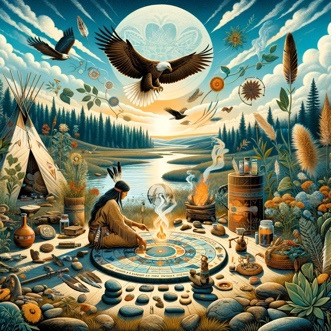
Introduction to Navajo People and Hózhó:
If you are visiting the state of New Mexico in the U.S., it is more than likely that out of every 20 people you meet, at least one will be of Navajo origin, descended from an ancient, one-thousand-year-old cultural lineage (HRSA, 2023; New Mexico Tourism, n.d.). The Navajo culture first came into existence when a small group of Native American Indians split away from their fellow Athabaskan-speaking tribe members in Canada and migrated south to the Southwestern part of what is the present-day United States (Encyclopedia Britannica, n.d.).
For the next few centuries, the Navajo people saw immense success as farmers and gatherers and flourished to become one of the most prominent native tribes in North America. But then, just as the Navajo tribe was entering its prime, disaster struck in the form of 17th-century European colonialists as all but a few of Navajo tribespeople were either killed, enslaved, or displaced to relocation camps, causing the 60-million-strong pre-Columbian population to spiral down to only a pitiful 22,465 remaining descendants by the end of the 19th century (IPUMS, n.d.; Koch et al., 2019). However, the Navajo people quickly adapted to Western dominance in the 20th and 21st centuries and managed a magnificent cultural comeback, with the modern-day Navajo Nation spanning 16 million acres across New Mexico, Arizona, and Utah (Encyclopedia Britannica, n.d.). Even more impressive, a 2020 population census shows that more than 425,000 U.S. citizens claim Navajo descent. So, in the end, this brings up the question—what exactly enabled the Navajos to be so successful in adapting first to a brand-new world in Southwestern North America and then to the brutal European colonization? Ultimately, this responsibility comes down to the philosophy of Hózhó—balance, harmony, order, and wellbeing—the idea at the core of Navajo culture that contributed so much to the prosperous success experienced by the Navajo people.
Navajo Creation Myths:
When discussing Hózhó, it is necessary to mention the Diné Bahane’, the Navajo creation myths, which materializes the abstract idea that makes up the basis for the Navajo life. Even in the beginning of the Diné Bahane’, where the ancestors of the Navajo people—First Man, Áłtsé Hastiin, and First Woman, Áłtsé Asdzą́ą́—were created, the theme of Hózhó was apparent. As the story goes, the two powerful beings were born in the first world, Niʼ Hodiłhił, with “First Woman standing in the West, far away from the First Man standing in the East” (Gallo, 2019, para 11). Apart from the opposing locations, First Man and First Woman also represented contrasting elements. According to Gallo, “First Woman represented darkness and death, whereas First Man represented the Dawn, and Life.”
The presence of First Man and First Woman created a balance between light and darkness, life and death, male and female, bringing a harmonious state of coexistence into the world while establishing the central theme of the Navajo people as bringers of harmony, peace, and prosperity. Even after the glorious entry of First Man and First Woman into the world as upholders of the Hózhó, this idea still is echoed throughout the Diné Bahane’, as new sets of characters with counterbalancing elements emerge, such as figure of Coyote First Angry, Áłtsé Hashké, representing disorder and chaos, and his counterpart, Spider Woman, Na'ashjé'ii Asdzáá, representing order and harmony (Gladd, n.d.). Thus, enabled by its profound association in the Diné Bahane’, Hózhó is deeply rooted in Navajo culture.
As accounted in the Diné Bahane’, First Man and First Woman, along with the air-spirit people, journeyed through four worlds before finally settling in the fourth world, Earth. In actuality, the travels of First Man and First Woman are more or less portrayed as a continuous quest of seeking true harmony and balance, with each transfer between worlds a direct result of imperfection in their understanding of the Hózhó. First Man and First Woman left the First World due to jealousy and bickering. In the same sense, the departure from the Second and Third World was driven by lust and greed respectively, because First Man, First Woman, and the air-spirit people “still had not changed their way of life and they were not yet living in balance and harmony” (Gladd, 2019, para 22). This theme of pursuing the Hózhó in the Diné Bahane’ laid the foundation for the ideal of Hózhó as a rudimentary way of life for the Navajo people and represented their respect as well as appreciation for the wise philosophy.
In the Diné Bahane’, this quest in search of harmony persisted into the Fourth World, where the Navajo people acquired full prosperity and perfection of Hózhó with the help of Changing Woman, Asdzaa Nádleehé. The Changing Woman is a well-respected entity in Navajo religion, not only creating Navajo Race out of her own skin but also giving birth to the hero twins—Naayéé’neizghání, Monster Slayer, and Tóbájíshchíní, Born for Water—who removed the monsters terrorizing the Navajo people (Twin Rocks Trading Post, n.d.).
However, perhaps the most significant contribution by Changing Woman was the introduction of the Hózhó ideal. Traditionally speaking, it was the Changing Woman who established Hózhó as a fundamental way of life for the Navajo people. Among other teachings that emphasized respect for Nature, Changing Woman revealed the secret of growing corn to the Navajo people as the key to a congenial relationship with Nature. Additionally, the Changing Woman also introduced a number of rites, named the Blessingway, Hózhójí, through which the Navajo people can seek harmony in their spiritual connection as well as pursue healing and wellbeing. As will be explained further in the latter parts of the presentation, these rituals would become one of the most important practices in Navajo culture, uniting them spiritually in the pursuit of prosperity and practice of Hózhó.
Ultimately, at the bottom of all this is Changing Woman’s amazing ability of senescence and rejuvenation—the quality that gave Changing Woman her name—in which she "renews itself (herself) in spring and gradually dies with the coming of winter, only to begin anew the pattern of seasonal rebirth the following spring” (Twin Rocks Trading Post, n.d., para 4). Through this, Changing Woman embodied the annual life cycle of the seasons, symbolizing the Navajo people’s ultimate acquirement of harmony and oneness with the four seasons as well as life and death. As Katherine Spencer, as quoted in Twin Rocks Trading Post (n.d., para 2), wrote in her book, Navajo Chantway Myths, “Through the birth of Changing Woman, the emergence [by the Navajo people] into the Fourth and final World becomes complete” Changing Woman is not only the foremother of the Navajo race but also the pioneer of Navajo society, laying the groundwork for the important role of Hózhó as a principle for life in Navajo culture.
Navajo Sand paintings:
Among other practices reflecting the Navajo tribal emphasis on Hózhó, sand paintings take the place as one of the most important aspects of the Navajo daily life. Navajo sand paintings, also known as Iikaah—places where the gods come and go—in the Navajo language (NavajoPeople.org, n.d.), are a vibrant exhibition of Navajo culture’s craftsmanship. However, more than anything else, it is deeply connected to Navajo religious beliefs, representing many of their spiritual entities in its intricate designs. As stated in a blog posted by NavajoPeople.org (n.d., para 2), “The figures in sand paintings are symbolic representations of a story in Navajo mythology. They depict objects like the sacred mountains where the gods live, or legendary visions, or they illustrate dances or chants performed in rituals.”
Navajo sand painting represents a sacred symbol in their belief. For example, the design of an eagle in Sand paintings represents spiritual strength. Besides that, there are also plenty of meaningful elements symbolizing different elements in Navajo sand paintings. The color red represents life and vitality, while yellow represents the Earth and the lands, and blue represents water (Native American Myths, 2025). Navajo sand painting’s embodiment of Navajo mythology gives it an important position at the center of Navajo culture and represents the attempt of the Navajo people to seek harmony with their spiritual sustenance, especially with their creator, the Changing Woman.
One of the most common types of sand painting is the healing sand painting. In healing sand painting, people paint stick figures representing the troubled person who needs healing (Navajo People, 2019). The Navajo People perform religious ceremonies around the sand paintings to promote healing in the depicted patient by invoking the powers of their gods. Additionally, the healing sand paintings also frequently contain designs symbolizing the various entities in Navajo religion. These symbolic artistic effects in healing sand paintings “serves as a pathway for the mutual exchange of illness and the healing power of the Holy People…and creates a ritual reality in which the patient and the supernatural dramatically interact, reestablishing the patient's correct relationship with the world of the Holy People” (Navajo People, n.d., para 6). In this sense, Navajo sand paintings help the Navajo people to pursue both physical and mental well-being and balance their connection with their spiritual beliefs. Through this, sand painting reflects the importance of Hózhó in Navajo life and culture.
Navajo Hogans:
Besides their sand paintings, Navajo hogans are another important and sacred cultural element. The hogans’ setup is deeply connected to their heritage. According to Twin Rocks Trading Post (n.d.), hogans symbolize Navajo connection to their religion. Most notably, no matter how the hogan's design might differ depending on the style and taste, it always maintains a uniquely circular shape. The roundness of the hogan symbolizes the sun, while its eastward-facing door ensures that the first thing a family inside sees each morning is the rising sun. Moreover, in the minds of the Navajo people, the hogan is also a living entity, with the smoke hole as its breathing hole, from which prayers of the Navajo people emerge and rise to the heavens. Through this, the Navajo people can seek harmony with the elements around them to ensure prosperity and well-being.
The hogan connects the Navajo people to their religion. As accounted in the Navajo creation stories, the first hogan was built by First Man and First Woman from sacred materials like black bow and reeds, which symbolize balance. In construction, cornmeal was sprinkled from east to west as a blessing for home. The interior of hogans is filled with symbolic meanings. The central fireplace represents the sun at the heart of the universe, while the four supporting beams align with the four directions to catch prosperity from all corners of the Earth. Hogans are used in various traditional rituals and ceremonies, such as blessingway ceremonies and healing rituals, while they also act as a gathering place for family and friends. (Twin Rocks Trading Post, n.d.). This essential role of the hogan in Navajo daily life further emphasized its contribution to philosophical Hózhó as a constitution for life.
Navajo Hoop Dancing:
Last but not least, the Navajo hoop dance is also a significant representation of the Hózhó. As presented in the previous sections, the Navajos have a rich spiritual and cultural heritage emphasizing connections to Nature through a complex system of ceremonies and rituals passed down through generations. This connection to Nature and spirituality is woven into the hoop dance, making it more than just a performance but a sacred practice that embodies the Navajo worldview (Encyclopedia Britannica, n.d). Among other traits, the hoop dance holds profound symbolic meaning in Navajo culture, representing wholeness, the interconnectedness of all things, and the cycle of life (Ya-native, n.d). The hoops used in the dance are not merely props but powerful symbols that convey spiritual and philosophical ideas. By manipulating the hoops into intricate formations, dancers visually depict the harmony and balance central to Navajo beliefs. The different movements in the hoop dance serve as a spiritual practice, honoring the interconnectedness of life and establishing a connection with the spirits, making it a profound expression of Hózhó.
The performance of the hoop dance highlights its sacred role in Navajo culture and its connection to spiritual and communal events. Hoop dancing is regarded as a sacred dance in Native American culture that acknowledges and connects with the spirits. Performed mainly during religious ceremonies like harvest festivals and Powwows, the dance is an ancient form of prayer that aims to promote communal welfare through the establishment of harmony with the holy people in Navajo Religion (Ya-Native, n.d.). In this unique function of the hoop dance, the value of Hózhó in Navajo culture and society is once again demonstrated.
Empowered by its connection with the philosophical Hózhó, Navajo hoop dance plays a vital role in the preservation of the Navajo culture. As Patrick Willies, a world-class Native American hoop dancer, explains that “just like many of our Native American dances, a lot of them (Navajo hoop dances) have different stories...the Hoop dance started as a healing dance, and that story is still there, but it’s also a storytelling dance” (Franklin & Willie, 2021). Through the hoop dance, performers keep ancestral stories and traditions alive, ensuring that the meanings and values behind the dance endure. The hoop dance has become a medium for storytelling, connecting the past with the future generations and contributing to the endurance of the Navajo culture over the ages.
Conclusion:
So, in the end, why exactly is the Hózhó so important to Navajo culture? Well, in actuality, the Hózhó isn’t merely an empty idea invented by some abstract thinker; it is an entire way of life for the Navajo people. More extensively put, the Hózhó is the cornerstone of Navajo society, rooted deeply in every aspect of Navajo Culture, from their mythology, the Diné Bahane’, to their residence, the hogan, their artistic expression, the hoop dance and sand painting, and much, much more beyond. As the Brigham Young University Museum of Art (2003, para 2) asserted, Hózhó, as “the essence of the Navajo philosophy,” enables the Navajo people to “strive for balance and harmony together with beauty and order.” Throughout the past millennia of struggles, the adherence to Hózhó has allowed the Navajo to ultimately pursue wellness through a state of harmony with both Nature and fellow cultures, leading them to overcome several crises and emerge victorious.
Indeed, the world has to learn much from the Navajo culture and its philosophy of Hózhó. Over the past one hundred years, humans have ruthlessly exploited Nature with deforestation, overfishing, and pollution, all the while unaware of the necessity of harmony, not dominance, in survival, a verity that Navajos have already discovered centuries ago. In the devastation of Nature, humans are slowly forcing themselves, step by step, toward the edge of no return. Nevertheless, if values such as the Hózhó can be recognized more extensively by the world, there is still hope for humanity to deliver and redeem itself. With that said, this is only the tip of the iceberg of what Native American culture, like the Navajos, has to offer if only the rest of the “civilized” world could care to listen. From the use of the three sisters—corn, bean, and squash—in Iroquois and Cherokee agriculture to the Navajo Hózhó philosophy, there is invaluable wisdom in Native American cultures.
When the European colonialists, assured in their majesty, discovered the Navajos and other Native American tribes, they deemed the foreign race inferior due to their own based on their exotic ways and inability to resist. However, it is now apparent that for all their supposed progressiveness, the Europeans failed to appreciate the advancement of the Native American cultures in their thinking and worldviews. More than 400 years after the Europeans, in a society that values diversity and equality above all else, safeguarding Native American cultures such as the Navajos becomes increasingly important as the world realizes the wisdom in their philosophies. Humanity is indeed fortunate that the last century has seen a much-needed revival for numerous Native American Cultures. Novertheless, as Ruth Muskrat told U.S. president Calvin Coolidge in his 1923 speech, "the trail ahead for the Indian looks clear and bright with promise ... it is yet many long, weary miles until the end," and it is our job to awaken the world to the wonderfulness of these cultures and the importance of safeguarding them.
References
- Brigham Young University Museum of Art. (2003). Walk in Beauty: Hózhó and Navajo Basketry. Resource Library Magazine. https://www.tfaoi.org/aa/3aa/3aa513.htm
- Encyclopedia Britannica. (n.d.). Navajo. Britannica School. Retrieved February 25, 2025, from https://school.ebonline.com/levels/middle/article/Navajo/55069
- Franklin, A. & Willie, P. (2021, November 18). This Navajo Hoop Dancer Finds His Fire in the Beat of Pow Wow Drums. Thrillist. https://www.thrillist.com/navajo-hoop-dancer-profile
- Gallo, L.N. (2019, March 26). An Origin Story: The Navajo. Penn State University. https://sites.psu.edu/wisdom/2019/03/26/an-origin-story-the-navajo/
- Gladd, J. (2019, August). 3. Navajo Diné Bahaneʼ. College of Western Idaho. https://cwi.pressbooks.pub/americanliterature/chapter/navajo-emergence-myth/Gladd, J. (n.d.). 68. Hózhó and Navajo Artifacts. College of Western Idaho. https://cwi.pressbooks.pub/americanliterature/chapter/hozho/
- Health Resource and Service Administration. (2023). III.B. Overview of the State - New Mexico – 2023. https://mchb.tvisdata.hrsa.gov/Narratives/Overview/9d5e3e26-084b-4f34-8874-c9514c3a49e9
- Integrated Public Use Microdata Series. (n.d.). The total number of Indians. https://usa.ipums.org/usa/resources/voliii/pubdocs/1910/Population/00420142ch1.pdf
- Koch, A., Brierley, C., Maslin, M.M., Lewis S.L. (2019, March 1). Earth system impacts of the European arrival and Great Dying in the Americas after 1492. Science Direct. https://www.sciencedirect.com/science/article/pii/S0277379118307261?via%3Dihub
- Native America Myths. (2025, February 7). The Meaning Behind Navajo Sandpaintings: A Visual Mythology. Mythology Worldwide. https://nativeamerican.mythologyworldwide.com/the-meaning-behind-navajo-sandpaintings-a-visual-mythology/
- Navajo People. (n.d.). Navajo Sandpaintings. https://navajopeople.org/navajo-sand-painting.htm
- Navajo People. (n.d.). Navajo Homes – Hogans. https://navajopeople.org/blog/navajo-homes-hogans/
- New Mexico Tourism. (n.d.). Navajo/Diné. https://www.newmexico.org/native-culture/native-communities/navajo-nation-dineh/
- Novin, G. (n.d.). Chapter 78; Navajo Indians sand painting. Blogger. https://blogger.googleusercontent.com/img/b/R29vZ2xl/AVvXsEhrVaeHT0qLcAisVRtbEZ9Nothg0LmhK6ilzq8MpDr1-1GyCKWOVtkRyTyEqTp7czZbCjISoan31vaiD9yq91_OgTGXjmFCb2yOiLfvhAPNQKKpyNI1rjJYXfsJVCJ1s3za2yJ-IUF8224/s1600/zz1.jpg
- Timi More. (2025, January 19). Navajo Changing Woman (Full Story). [Video] YouTube. https://www.youtube.com/watch?v=0mfJwO6idJc
- Twin Rocks Trading Post. (n.d.). Hogan. https://twinrocks.com/legends/environment/hogans.html
- Twin Rocks Trading Post. (n.d.). Navajo Changing Woman. https://twinrocks.com/legends/dieties/navajo-changing-woman.html
- Ya-Natives. (n.d.). Introduction to Hoop Dancing. https://www.ya-native.com/nativeamerica/introductiontohoopdancing.html
This is a from an English class presentation about the Navajo Culture. Published with the consent of all members of the research.