Introduction
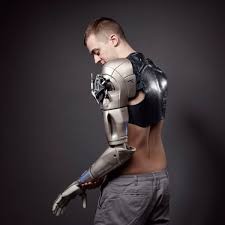
Recently, I came across a reading in National Geographic's Explorer magazine (available on Scribd page 150) concerning the progression of human bionics in patient recovery, which, simply put, is the integration of the human body with mechanical extensions to enhance human capabilities or restore lost functions. Human bionics is a rapidly developing technology ranging from prosthetic limbs to artificial organs and cochlear implants that poses the potential to change our daily lives dramatically when it comes to full fruition. However, despite the promising future of human bionics, I couldn't help noticing the potentially dangerous side effects this technology poses to our society.
Medical Concerns
Perhaps the most significant problem with the technology, human bionics, involves the combination of the human body with artificial devices, and that inevitably raises several health safety issues. On top of the medical risk in the initial implantation that comes with any operation on the human body, the maintenance of the implants is a serious concern. Machinery wears out eventually, and at some point, the implants would have to be removed for repair or replacement, entailing more operations and an increased risk of accidents leading to damage to the human body.
Besides that, the junction between the artificial implants and the human body also presents the risk of infections. For exterior parts such as artificial arms and legs, the passageway for a bacterial invasion is very clear: bacteria and other germs could enter the human body through linking components, such as electric wires connected to nerve endings that relay signals from the brain. Since the implants in these cases are exposed to the outside world, they would collect a huge amount of contamination, and no matter what measures are taken to prevent infection, the chances are still extremely high. Meanwhile, health risks can also stem from interior implants. Bacteria could be simply present on the implant itself, leading to severe inner infections, or more likely, the presence of a foreign object inside the body could stimulate a rejective response from the immune system, causing the body to damage itself and making it vulnerable against subsequent bacterial attacks. In fact, a report from the National Library of Medicine of U.S. has documented infection rates of HBV-ACLF patients with artificial liver implants at 43.6%, while another report shows 38.3% of patients experiencing infections after Transcutaneous Osseointegrated Prosthesis Systems (TOPS) implants—a form of prosthetic limb installation.
Social impacts
With the medical challenges arising from failed human bionics being said, we still have to consider the implications of successful implants. While a properly done human bionics implant would be hugely instrumental in a patient's recovery and even rehabilitation, this measure takes the pressure off of the human body, which, despite what most people believe, can actually have a bad effect. Because healing itself after injury is part of our body's instinctive function, letting human bionics execute the healing for it would mean the ability to self-heal is now useless, making our body gradually lose the ability to to self-repair, just like how our ape ancestors discarded their tail through evolution. Already, there are evidence of how dysfunctional our body would become with extensive use of "aiding" technology, such as the gradual hearing loss caused by earphones. Over time after time of human bionics implementation, our bodies would become increasingly reliant on this technology until artificial healing is needed for every small cut and bruise. Humans would be completely dependent on human bionics for every part of their lives, and what is more, the enormous number of artificial implants would have transformed humans to a stage where they are practically unrecognizable.
This brings us to another aspect of human bionics: Ethics. Would a person still be considered "human" after its body parts have been replaced by machinery? After all, what is the boundary between "human" and "robotic?" Of course, most people would agree that someone who has had their amputated arm replaced by a mechanical arm or an artificial kidney implant is still quite human, but what about someone who has had the entirety of their body except their brain taken place by artificially made body parts? Imagine that: a human brain connected to a robotic body; would you say if this is more human or robot? Well, if you are still comfortable with that, what if the artificially constructed body in the previous case doesn't even retain the standard human form of two legs, two arms, one torso, and one head? Unfortunately, there is a significant gray zone between human and non-human, and the potential capability of human bionics to replace any human body part crosses that zone. What would the future of mankind look like when everyone's body has become mechanical with only their brain left as a trace of the once flesh-and-blood creatures that they were? Although this scene might seem only possible in a sci-fi movie, the circumstance is totally achievable given the existing success scientists have already had with linking artificially-made body parts directly to nerves connected to the brain, and human bionics is seriously threatening people's viewpoint of their physical identity.
Furthermore, implementing human bionics can also dramatically change people's views on how to treat their bodies and the value of life. As we have discussed, the almost magical healing power of human bionics can pose major problems to our society, but the potential effects are much more severe than a few challenged ethical ideas. In a world where any part of a person's body, whether it's a heart or a finger, can be healed by being replaced through human bionics after damage, people would become more and more reckless at committing actions that pose harm to their bodies or even worse, intentionally harm other people. With the power of omnipotent self-recovery, violence would run rampant since almost any injury could be cured. In a world like that, everybody would be immune from death, and yet no one would be actually saved. More realistically, imagine the technology of all-healing human bionics in the hands of terrorists; how fanatic would they become with the reassurance that none of their actions would have long-lasting damage to themselves? Would this be the kind of society that you want to be as our potential future? Well, not for me.
Conclusion
In truth, like many other transformational technologies in the 21st century, human bionics have the potential to cause great damage to our society if it is mishandled. This is the problem with the progression of technology; it frequently presents profound implications that can be cut both ways, and if we are not careful when using it, there can be disastrous effects. Writers as early as Marie Shelly (author of Frankenstein) have warned us about this in their imaginative story worlds, and we have seen the terrible consequences of brashly treating technology in the ongoing crisis of Global Warming and the nuclear standoff during the Cold War. Technology not only gives people the power to change the world for the better but also the power to change for the worse, and as more technology becomes available to man, the risk of something going wrong will also increase. As the old saying goes, "Power brings out the worst in people," but if we are to survive the rapid technological advancement in the next hundred years, we must find a solution to educate people so that they can view the power that comes with technology with respect, not disregard.