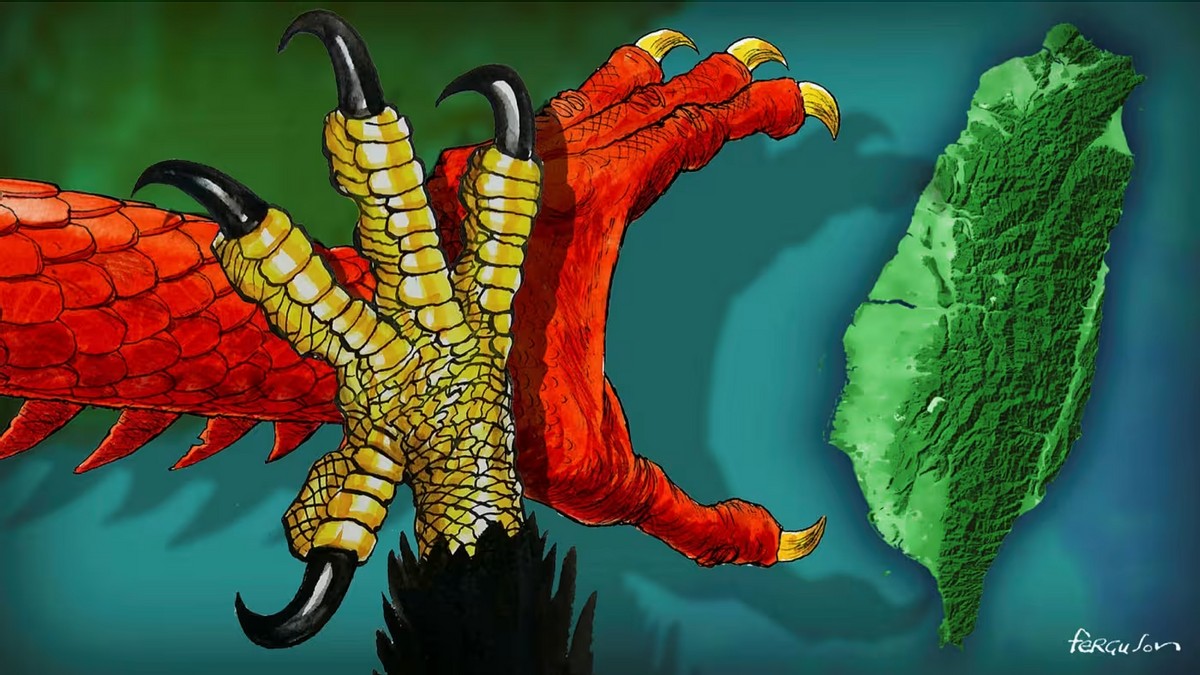
Intro
In the complex landscape of modern geopolitics, there are many hegemonic states, with those who bully weaker countries and those who stand up for others standing out among the many others. When it comes to the abusers of force, the image of Russia and its president, Vladimir Putin, springs to the mind of most people, but in fact, there is another more dangerous power looming just over the horizon—China. For more than a century, China has been maliciously eyeing Taiwan while the little island struggles to break free from the grasp of the giant, and now, as pressure mounts between China and the other countries for control of the South Sea, the PRC is determined more than ever to "reunite" Taiwan with her "loving family." In this article, we will be looking into why Taiwan has been able to maintain its sovereignty for so many decades and why it should not relinquish that status.
Taiwan's History
Historically speaking, Taiwan and China have had a long history of being at odds with each other, with Taiwan existing in a state of self-governed independence prior to the 17th century. Within that period, the indigenous people of Taiwan developed unique social structures and cultural practices such as the Bunun Harvest Festival, the Sediq Lahu Festival, and the Pangcah (Amis) New Year Festival. These diverse traditions set Taiwan apart from its neighbors and later governors, and therefore, it could be argued that Taiwan has historic sovereignty rights and that the CCP's claims of past ties are weak at best.
After this isolation, Taiwan came under the Japanese empire and, within this influence, continued developing diverse cultural beliefs separate from China. For example, Children's Day is celebrated on April 4 instead of June 1, the official date in China. In addition, Taiwan also has a more open society than China, with Taiwan's legalization of same-sex marriages in 1029 reflecting the island nation's emphasis on individual freedom and LGBTQ+ rights. China, on the other hand, remains old-fashioned as always, looking down on LGBTQ+ persons and only encouraging heterosexual relationships.
As a result of these differences in cultural beliefs and social ideas between Taiwan and China, the Taiwanese people have formed an independent national identity over the past decades, with most considering themselves as belonging to a separate nation. This cultural-born nationalism was further enforced by the end of the Chinese Civil War and the arrival of the Kuomintang, or KMT, in 1949. From then on, the KMT entered Taiwanese politics, establishing the Republic of China (ROC) and further distancing Taiwan from Communist China.
The Power Of The Public
The final step toward Taiwan's sovereignty came with a shift in the Taiwanese government. Following the spread and upsurge of the Taiwanese democratization movement, Taiwan became more and more inclined toward democracy, with the abolishment of the martial laws leading to the official recognition of multiple political groups in the 1980s and the first public presidential election in 1996. Taiwan's multi-party system further set it apart from China, which favors Authoritarianism over Political Pluralism, and in the minds of the Taiwanese people, their island home has just improved with the increased freedom of opinion, and they took pride in that.
The resulting independent nature of the Taiwanese people is evident in numerous aspects. One such display is Pew Research Center's June 2 to September 17 poll, which shows that among all 2,277 adult respondents, a staggering 67% percent consider themselves primarily Taiwanese while only 3% consider themselves Chinese. Furthermore, the poll also compared data on the same topic between respondents in the age group of 18-34—83% and 1%, revealing that not only was the tide heavily in favor of an independent Taiwanese ethnic identity, but that the younger generation stands at the forefront of this independent movement, pointing to the spread and inclining trend of nationalism among Taiwan.
Further investigation shows that the reason for the increased Taiwanese patriotism lies in the current political landscape. As the country described as the "threat to freedom and democracy" by Boris Johnson, it's not surprising that in an effort to further strengthen the "One China" policy and its military presence in the South China Sea, China has redoubled the pressure on Taiwan more than ever, both publicly challenging Taiwan's sovereignty and warning Taiwan's ally "not to play with fire." This offensive moment threatens Taiwan's fragile autonomy and, as a result, provoked a sense of national apprehension and urgency in Taiwanese teenagers.
The product of this burst of patriotism can be seen in the same Pew Research Center survey mentioned before. In a separate sector of the data analysis, results show that a total of 66% of Taiwanese adults view China as a major threat, with the percentage of respondents in the 18-34 age group being even higher, at a level of 72%. This high percentage level represents itself as a progressive increase from the 57.4% respondents in 2021, showcasing the ever-looming Chinese threat and the clear-eyed awareness of the Taiwanese while further demonstrating the resolution of that people to defend their sovereignty and rights.
The Struggle Independence
Through their new-found inspiration against Chinese oppression, Taiwan has managed to score several points in the past couple of decades. First of all, there is the political front. As China continues to bully Taiwan and her allies through diplomatic pressure and economic leverage in the hopes of discouraging those countries who would stand up for her, Taiwan has succeeded in making unofficial bonds with some 59 countries including the U.S., Canada, the U.K., and Australia, with the U.S., Australia, the U.K., Japan, Singapore, and the Philippines all congratulating Taiwanese president Lai Ching-te on the DDP victory in the 2024 election. These nonpublic alliances have been instrumental in ensuring Taiwan's safety from a malicious China and would be crucial for maintaining Taiwan's position on the global stage in the future.
The other factor that contributed in deterring China up to this point is the constant modernization of the Taiwanese military. Conscious of the imminent CCP threat just over their border, Taiwan has sought to strengthen its military at every possibility, with the 21st century witnessing a massive spike in Taiwan's military investment, from NT$320 billion (approximately $10.5 billion) in 2010 to NT$615.8 billion (approximately $20.3 billion), roughly double the spending. This increasing appreciation for militarization allows Taiwan to pursue various upgrades in its arsenal and enhance its combat capabilities in both land, sea, and air with the F-16V Fighter Jets, PAC-3 missile defense system, Narwhal-class submarines, and CM-34 Clouded Leopard armored vehicle being just a few among the modern weaponry obtained by Taiwan in the 21st century.
Of course, these assets are virtually nothing compared to the sheer size of the PLA, but nevertheless, these cards that Taiwan has up its sleeves still present a formidable challenge in the way of a Chinese invasion. For the price of overrunning Taiwan, China faces the prospect of its poorly-trained and non-combat-ready military being dealt catastrophic blows by the Taiwanese resistance. Xi does not want to become the second laughing stock of the World (the first being Vladimir Putin and his disastrous invasion of Ukraine), so he has avoided breaking the delicate standoff with Taiwan and escalating situations into all-out war. As Admiral James Stavridis, Former NATO Supreme Allied Commander, has said, China may look like the tough guy that Xi pretends to be on the surface, but its numerous weaknesses—most notably the corruption within the command structure and the unpreparedness of the Chinese army in the face of the complexity of modern warfare—all render China's combat capabilities feeble and ineffective. Xi knows this, and he won't press the button for an invasion of Taiwan without significant pressure from other countries to prove that China is indeed a world power (and significant deliberation would be needed even at that).

super interesting read!!!!! your grammar is almost perfect and the spelling is really good too, well done! this must be an assignment right hahaha