| INTRODUCTION |
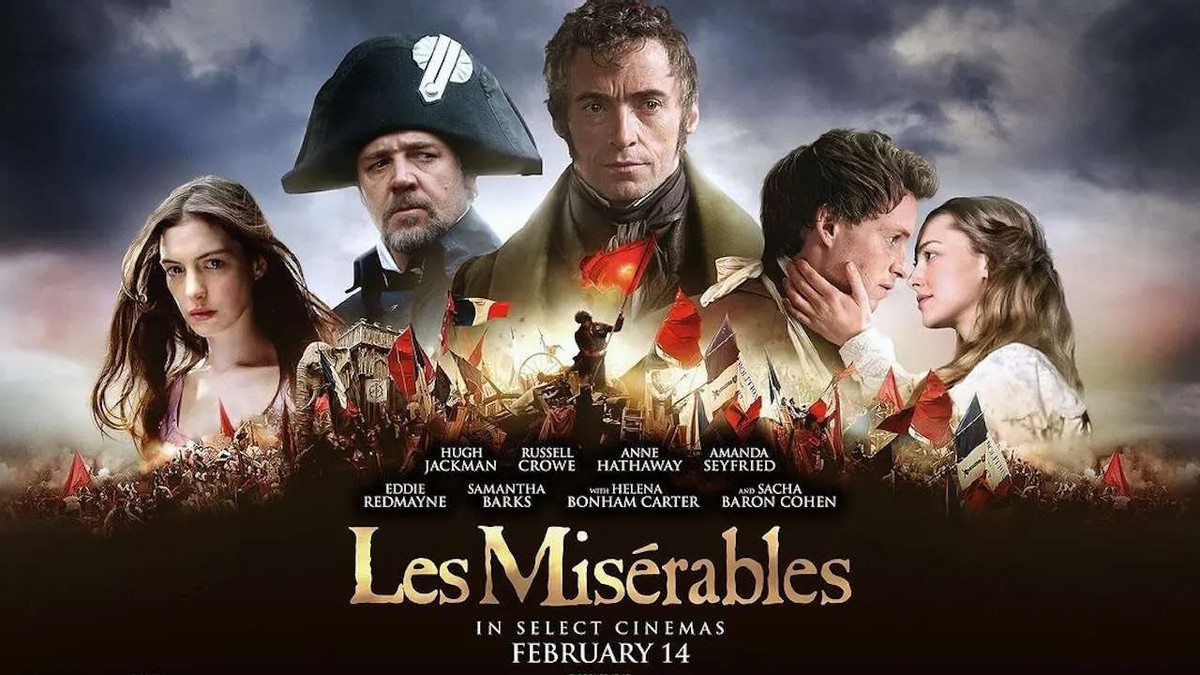
In 2012, Working Titles Films and Universal Pictures produced a musical adaption of the book Les Misérables that became renowned for its live singing performances. This work of art, also titled Les Misérables, depicts the life story of an ex-convict named Jean Valjean and the course of the June Rebellion of 1832, which aimed to liberate the people but failed disastrously. Les Misérables is actually an American production that uses British actors to describe a French event, and, although it may not have been historically accurate, this film succeeds in capturing the attention of viewers while offering them an insightful portrayal of both the religious and physical struggles of proletariats in a post-revolution France.
- | MUSICAL QUALITIES |
Before discussing the revelations brought by Les Misérables, it is essential to understand the musical nature of this film, which set it apart from other productions and is arguably the main reason for its success. Les Misérables is, in essence, a sung-though musical, meaning that nearly all of its dialogue is in musical forms. In fact, in a mere 135 minutes, Les Misérables managed to encompass a total of 41 songs, from "Do You Hear the People Sing", to "Look Down", "Red & Black", and "A Heart Full of Love". This diverse variety of rhymes, melodies, and rhythms seduces the audience, keeping them enthralled so that they experience the entire 135 minutes of Les Misérables in awe and fascination.
In addition to capturing the viewers' attention, the many forms of music included in Les Misérables also effectively convey the emotion and sensation of the characters involved to the viewer. In Les Misérables, characters express their feelings not through actions or facial changes but by singing songs. This, along with the hand gestures that the character makes, produces an emotional impact upon the viewer, which is greater than any words they could have uttered. Furthermore, Les Misérables also uses the differentiation of songs to enhance the effect by using tones, melodies, and pitches corresponding to the character's emotions. By doing so, a second layer is added to the atmosphere, and when combined correctly, these elements mentioned above —lyrics, tunes, melodies, and pitches— create an irresistible empathy with the viewers that draws them in and immerses them.
| JEAN VALJEAN & INSPECTOR JAVERT |
Two of the primary main characters in Les Misérables, Jean Valjean and Inspector Javert are also one of the prominent pair of antagonists in the film. In the exposition of Les Misérables, Jean Valjean had been enslaved in the galleys for 19 years simply for stealing a loaf of bread, and the story starts when his parole finally comes. Inspector Javert, Valjean's prison master at the time, was reluctant to release Valjean, and even though Valjean eventually got his freedom back, Javert made Valjean's passport permanently yellow so that Valjean would not be accepted anywhere. Twenty years later, Valjean and Javert had gone their separate ways: Valjean had founded a new life, rising to the mayor of Paris and caring for the poor, while Javert to the Chief inspector of Paris, waging his prosecution of the poor more than ever. Thus, the conflict continued in Paris, with Javert constantly trying to recapture Valjean.
From the perspective of the storyline, it may seem to the viewer that Valjean is the innocent and kind angel, and Javert, the vengeful demon, but the truth was far from it. In fact, Valjean and Javert are two men who both believe in justice and God but pursue it in different ways. Valjean set his life to benefit and aid others in need —the sick, the disabled, and the poor. Valjean's kind conscience was so great that at one time, he revealed his past as a dangerous convict to Javert and put himself in danger simply to save someone who was mistaken for the past him. In Les Misérables, Valjean represented the kindly side of law, warm, caring, and helpful. Javert, on the other hand, was born in a jail, and since he was a teen, Javert has dedicated his life to maintaining justice by enforcing the law upon others, often violently. In Les Misérables, Javert represented the harsh side of the law, strict, punishing, and unforgiving. Although Javert's aspect of the law is useful in dealing with truly hazardous prisoners such as murderers and terrorists, it should not be the reality for the thousands of poor French laborers at that time. Sending the innocent and desperately poor to the gallows for forced labor is just as hideous as the Nazi Concentration Camps. As Valjean pointed out, in being sent to the gallows on ridiculous charges, Valjean himself and many others had been enslaved by the law.
Apart from representing different aspects of the law, Valjean and Javert also symbolize different sides of religion at that time. Valjean symbolized the Protestant branch of Christianity, while Javert symbolized the Catholic Branch. In Les Misérables, it was Valjean's acceptance of others, both poor and rich, that allowed him to be so sympathetic and benevolent. In retrospect, Valjean believed in the strictest conduct of the rule and the eternity of repentance. The best statement that could represent Javert's beliefs is his words to Valjean: "Dare you talk to me of crime and the price you had to pay. Everyman must pay his sin. Everyman must choose his way."
| THE JUNE REBELLION |
The climax of Les Misérables, the June Rebellion of 1832, is also a genuine historical event, portrayed with perhaps a little more exaggeration and vigor than needed. Instead of depicting the event as it happened, Les Misérables altered the rebellion into an uprising led by young men, who became dissatisfied with their miserable reality and developed ideas of liberty and equality. But despite their admirable intentions, the rebels failed to gain the support of the hesitant people and were slaughtered. However the case may be, the June Rebellion's depiction reflected the oppression, anger, and suffering inflicted upon the commoners at that time.
Upon seeing the depiction of the June Rebellion, one can't help but connect this failed rebellion that only existed in fiction with dozens of other similar events that took place in the modern world and cost the lives of hundreds of students. The 1968 Tlatelolco Massacre in Mexico, the 1989 Tiananmen Square Protests in China, and the 2011 Syria Revolt, all of these horrific bloodsheds were initiated by students and people of the young generation and in truth, could have been avoided if only the the young men had chosen a more peaceful way for their voices to be heard. Through analysis of these events, one lesson can be derived: Although young people have the spirit, energy, and knowledge to address the many problems our world faces, they are too brash to succeed, and sometimes, the older generation needs to step in and solve the issue in a smarter way.
| CONCLUSION |
Using amazing musical creations, touching content, and wise insights, Les Misérables was able to enchant the audience thoroughly, and when the film ends, viewers would feel as if they had just awakened from a dream of a world that is both better yet worse than life on Earth: Better in the abundance of music, kindness, and virtue that exist among the ordinary people and worse in the presence of poverty, violence, and hatred that seems unshakeable in its dominance.