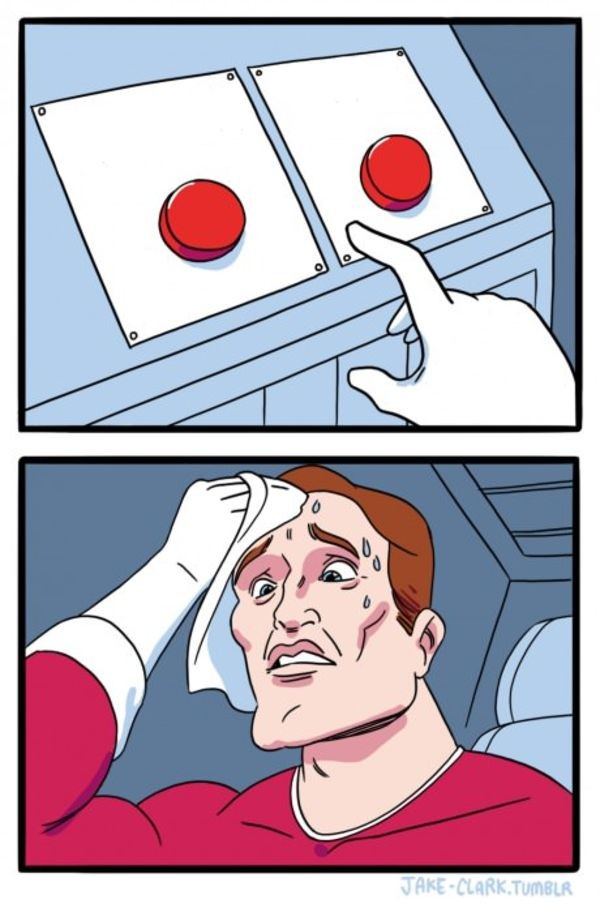
Have you ever thought about the privileges you have as someone living in these times? We have the ability to jump on a plane and move to any spot on the planet in no time, while watching a premiere blockbuster in a comfortable seat. Would you like to book an appointment with the dentist, order takeaway or shop for that new pair of jeans? All this and more can now be done right from the comfort of your own living room. The problem is, the Internet and other technologies have not only provided us with comfort and convenience, but also with problems such as inequality, unrealistic standards of beauty, FOMO (Fear of Missing Out) and depression, and the list goes on.
Among these issues is the problem of choice. Even though today we can go to a supermarket with hundreds of brands, we're often hard put to pick one out of so many options. Our ancestors could probably never have imagined such a thing as the "paradox of choice" in their tough and perilous lives. Indeed, while you're running from a tiger, thinking about what you're going to eat that day (assuming the tiger doesn't eat you first), there’s not much time to think about anything else. Even if they did have time to think about anything, they wouldn’t have been ranting about abundant choices, but rather about the lack of food.
So, people continue to be unhappy because they can’t choose anything. It would sound funny if it weren't so sad. That is to say, while on one side of the planet, people are struggling to find enough food to eat, someone on the other side is struggling because they can’t decide on what to eat. To poor, disadvantaged people, this probably not only sounds ridiculous but insulting. But that's the reality of the world we're living in. The problem of choice arises when there’s an excess of resources, and by that I mean not only t-shirts, toys, and stuffed animals, but anything at all.
Eventually, we find ourselves unable to choose not only a career or a place of living but even friends and partners. With the prevalence of the Internet, we've been given unlimited access to online dating apps and sex cam sites, increasing the pool of potential partners exponentially. Unlike our parents, we can no longer simply meet someone on the street or at a party, hang out for a while, and get married because we won’t be satisfied with just that. A staggering plethora of potential paramours make it virtually impossible for us to refrain from swiping that bloody dating app. Even if we were to stay with one partner for a while, this endless online black hole is too appealing, mesmerizing us with promising perspectives and even more affectionate lovers than the one we have presently.
Dating apps and their impact on people’s relationships may sound like an extreme and even intimidating example of this phenomenon. Nonetheless, why should we limit ourselves, especially when so many people get tricked into the Samsara wheel of consumerism? First, you're given an unlimited smorgasbord of items to choose from, whether it be fashionable dresses or brand-new televisions. Then you choose something and buy it only to think shortly thereafter that this thing isn’t good enough for you. But why do you think that way? Because you caught sight of other items in the shop — more expensive, cool or just flashier.
What should we do with this modern curse of choice? I wouldn’t recommend retreating to the wilderness to spend the rest of your life in seclusion. You probably wouldn't even consider the wilderness unless it had WIFI, an ATM, and a decent hotel. What I would suggest is the opposite — stay where you are. Whenever you swipe on Amazon or Tinder, think about how many hundreds of swipes it'll take to find what you want. Objectively, what is “what you want”? What if you never find it here? Is it possible that it’s not you who’s swiping, choosing people and goods, but the big brands swiping you, maneuvering you like pawns on a chessboard? Think about that the next time you once again find yourself unable to choose and maybe this time, armed with that knowledge, you'll be less likely to jump on that treadmill of endless choices.

Definitely something to think about! I'm all to often guilty of taking for granted how many choices I have at my disposal.
Thank you for your comments. I also feel guilty sometimes, especially when I waste money on some unnecessary stuff :)